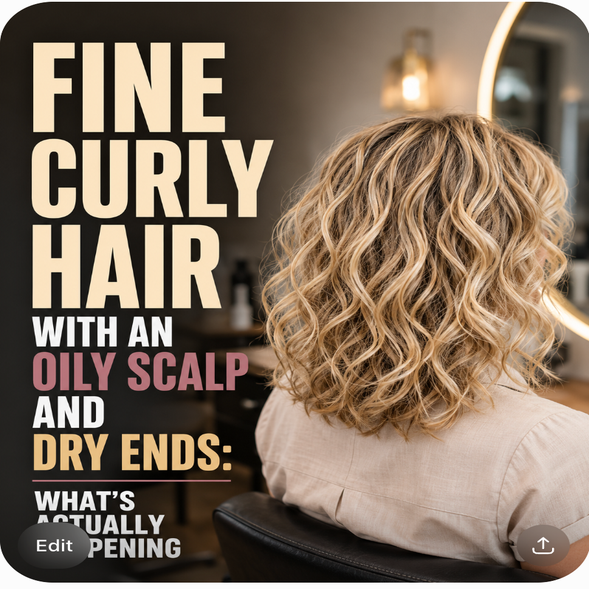
Do you ever notice your curls falling flat or straight at the crown while the rest of your hair looks defined? This is one of the most common curly hair frustrations, and the first thing worth knowing is that it is rarely something you did wrong. I dealt with a flat, stubborn crown for years, and I worked through the why with my friend, a hair scientist and cosmetic formulator with a PhD in chemistry, so this guide gives you the honest version, not the hype.
Here is the short answer: a flat top comes down to two kinds of causes, and telling them apart is everything. Some are structural and largely fixed (your genetics, where your curl pattern starts on the strand, and how dense your crown is), and some are fixable (weight, buildup, layering, heavy or wrong products, over-washing, and damage). You cannot rewrite the first group, but you can style around it, and you can genuinely fix the second with lighter products, proper cleansing, haircut adjustments, and a few root-lift techniques.
First, Figure Out What Your Flat Roots Are Telling You

Flat roots are not caused by just one thing, and the pattern you see points you toward the cause. Match yours, then jump to the fix:
- Flat and greasy roots → buildup or heavy products (fixable).
- Flat with long or thick hair → weight pulling the curls down (fixable).
- Flat only at the crown, curls below → your natural curl pattern or a layering issue (mostly structural).
- Flat with frizzy, undefined texture → damage from heat or chemicals (fixable over time).
- Flat right after wash day → product choice or styling technique (fixable today).
- Crown used to curl but new growth has changed → consider hormonal, health, or medication-related changes.
Notice I did not say “moisture imbalance.” A flat crown is almost never about some internal moisture-protein ratio; it is usually about weight, residue, where your curl naturally forms, damage, or styling technique. If your natural texture itself has recently changed, however, hormonal or health-related changes may also be worth considering.
Structural Causes You Can Style Around (Not Erase)
These come down to how your hair grows. You cannot change them, but once you understand them you can style with them instead of fighting them, and you can stop blaming your routine for something genetic.
1. Genetics and Hair Type
Your curl pattern is set by the shape of your follicle, which is determined by genetics[1]. Many people naturally have more than one pattern on a single head, with a looser crown and tighter lengths, and that is completely normal, not a sign of damage or a mistake. You can learn to identify your texture in the curly hair types guide, which makes it easier to see whether your flat top is simply how your hair grows.
2. Where Your Curl Starts on the Strand (and Crown Density)
This is the single most reassuring thing to understand about a flat crown: on looser textures, the curl often does not begin until partway down the strand, so the roots read straight even though the hair is healthy .
Wavier types and early curl types like 3A show this most. Low density at the crown adds to it, because fewer strands means less natural lift up top. Neither is something you fix; both are something you add volume to with technique, which is covered further down.
3. Your Curl Pattern Has Changed Over Time
If the top of your hair used to curl and now grows noticeably straighter, the question is different from someone whose crown has always been loose. Hair texture can change over time, and hormonal shifts, including menopause, can affect the characteristics of newly growing hair. Major health events, significant physiological stress, surgery, and some medications can also affect hair growth and shedding.
The important distinction is new growth versus existing hair. If the hair coming directly from your scalp is growing with a different texture than it used to, styling products and clarifying cannot change the shape of that new growth. If your roots grow curly but become straighter farther down the strand, look instead at weight, buildup, heat, chemical damage, or styling.
If a sudden texture change happens along with significant shedding, thinning, scalp changes, or follows a new medication or major health event, talk with your doctor or dermatologist rather than assuming it is simply a curly hair routine problem.
Fixable Causes (and Exactly How to Fix Each)
These are the causes worth your energy, because small, targeted changes here make a visible difference at the crown.
3. Your Layers Are Working Against Your Curl
Layers can add shape, but if they are not cut for your curl pattern they can leave the top looking flat. On wavy-to-curly hair the curl often does not fully form until the mid-lengths, so short layers at the crown may not have the length to complete a curl, leaving the top straighter.
If that sounds like you, ask for long, blended layers rather than short choppy ones, a balanced round curly shape, and no overly short layers at the crown. The goal is to support how your curl forms, not cut against it.
4. Long, Heavy Hair Is Pulling the Crown Down
Even a good cut can fall flat at the roots if the overall length and weight pull the crown down. This is one of the most common causes, especially for thick or high-density hair.
Tell-tale signs: flat roots with curly ends, curls that look better right after a trim, and hair that feels heavy near the crown.
The fix is to remove weight: regular trims, a shape adjustment rather than just more layers, and a stylist experienced in curly cuts who can redistribute weight without disrupting your pattern. Lighter hair springs up more easily at the roots.
5. Buildup Is Weighing the Roots Down
Buildup on the scalp and roots is one of the most overlooked causes. Films from styling products, sebum, and environmental minerals (hard water, chlorine) accumulate and physically weigh the hair down and add friction, so curls cannot lift or clump at the crown[2]. This is not about residue “blocking moisture”; it is simple weight and coating.
Signs: roots feel coated or heavy even after washing, the crown looks dull, and curls improve right after you clarify. The good news is buildup is formula-dependent and washes out[2].
Work a clarifying or chelating shampoo into your routine: a gentle clarifier every few weeks, or a chelating wash if you have hard water or swim. Regular shampoo handles most of it; you do not need to fear cleansing.
6. Heavy or Wrong Products at the Roots
Rich butters, oils, and heavy creams are useful on lengths but too heavy for the crown, where hair needs lift. Applied near the scalp they weigh roots down, kill volume, and flatten curl formation up top.
Signs: roots go flat soon after styling, hair feels soft but has no volume, and curls look better when you use less.
The fix is placement and weight: apply most product to the mid-lengths and ends, keep the roots light (a lightweight mousse or light gel), and avoid stacking too many layers in one routine. Products are described by their job here, not by a hero ingredient on the label.
7. You May Be Over-Washing (Harsh Cleansing)
Washing too often with harsh, stripping shampoos can leave the scalp and roots feeling rough and the hair harder to style, which can read as a weaker, flatter crown.
The honest mechanism is not “lost moisture balance”; it is that aggressive surfactants can leave hair feeling stripped and high-friction, so curls clump less neatly[3].
A gentle, sulfate-free wash once or twice a week, rather than daily, usually settles this, with clarifying reserved for actual buildup rather than used as a routine.
8. Heat Damage at the Crown
The crown takes the most heat from dryers and irons, and repeated high heat wears down the cuticle and the bonds that let a curl form, so the top can go straight or limp while the rest still curls[4].
Signs: the top section will not curl even with styling, looser or inconsistent texture up top, and more frizz.
Limit high-heat tools, always use a heat protectant when you do use heat, and diffuse on low without concentrating heat at the crown. As new, undamaged hair grows in, the natural pattern returns.
9. Chemical Damage at the Crown
Color, bleach, and chemical services are applied first and heaviest at the crown, so that is where damage and curl loss show up most, often as frizz and lost definition no matter how much product you use. If you have lightened or chemically treated hair and the top stopped curling, that is the likely cause.
Focus on restorative care: regular conditioning and, on genuinely weak hair, a protein treatment to reinforce the strand; avoid further chemical services; and for severe cases see a trichologist or curl specialist. Improvement at the roots usually shows over about four to six weeks as you stop processing and the strand recovers and grows out.
10. Prolonged Use of Accessories
Hats, beanies, tight scarves, clips, and tight ponytails worn for long stretches press curls into a shape and can flatten the crown over time, especially on type 4 textures that are more prone to pattern disruption. Give your hair breaks from accessories, and use them strategically rather than all day.
Root-Friendly Products (by Job, Not Hype)
When weight, buildup, or heavy product is the cause, the right products help, and “right” here means low-residue and lightweight at the crown. Match the job to the problem rather than chasing a hero ingredient.
Gentle, low-residue shampoo (root-safe)
A sulfate-free shampoo that cleanses without leaving heavy residue keeps roots light so curls can spring up. Pick a straightforward gentle formula; skip anything sold on biotin or “follicle-stimulating” claims, which do not strengthen hair topically.
Clarifying and chelating shampoos (for buildup and hard water)
- Ouidad Water Works Clarifying Shampoo (removes buildup without stripping curls).
- Aluram Coconut Water Clarifying Shampoo (gentle clarifier).
Use once a month, or every couple of months, or a chelating wash if you have hard water or swim regularly.
Lightweight root volume (no heaviness)
Instead of heavy creams at the crown, reach for lightweight, flexible-hold options that lift without flattening:
- Ouidad VitalCurl+ Soft Curl Defining Mousse (weightless, silicone- and sulfate-free; apply root to ends and scrunch).
- Kevin Murphy Body.Builder Mousse (stylist favorite for fine curly hair needing root lift, and protein-free).
- K18 AstroLift Reparative Volume Spray (light root lift on damp hair before diffusing; use it for volume, not as a repair claim).
- Kristin Ess The One Signature Set (Shampoo + Conditioner + Texturizing Sea Salt Mousse) (soft texture and volume for wavy-to-curly hair).
Tip: rotate by job, a gentle shampoo weekly, a clarifier monthly, and a lightweight mousse when you want root volume, instead of layering heavy product at the crown.
Techniques to Lift and Curl the Crown
Whether your flat top is structural or fixable, these techniques add real volume and definition at the roots. They are the heart of what people are searching for, and most beat any single product.
Root clipping (the highest-impact trick)
This is the technique nearly every flat-roots guide and video centers on, and for good reason: it lifts the crown while your hair dries so the volume sets in place.
After applying product to wet hair, take small sections at the crown, lift them straight up, and clip at the base with metal or claw clips to prop the roots off the scalp.
Leave the clips in until the hair is fully dry, then remove gently. The aim is root volume that matches the rest of your hair, so you do not end up with full lengths and a flat top.
Clipping is the highest-impact trick, but it is not the only one. For the full toolkit, see my guide to adding volume to curly hair roots.
The upside-down dip-bowl method
Flip your head forward and dip your crown into a bowl of water with a little leave-in while scrunching. Getting the roots fully saturated helps the curl clump at the crown (where people are usually afraid to apply anything), and styling upside down builds root lift.
You will need: a large bowl, leave-in conditioner, an old T-shirt or T-shirt towel, and optionally curl cream, mousse, gel, and a diffuser.
Diffuse for root lift
Cup sections into a diffuser at the roots and gently push up toward the scalp; flipping your head forward adds crown volume. Use low heat to protect the strand[4]. A firmer-hold styler helps the lift hold.
Overnight volume for naturally straighter crowns
If your crown grows in straighter, set the top sections overnight (loose pin curls or clips, a little mousse or gel) so they hold a bit more shape by morning, finished with a light mist of hairspray. This styles around a structural cause rather than trying to erase it.
What If It Is Just Genetic? How to Style Around a Straight Crown
Here is the honest part most videos skip: if your crown is straight because of your genetics or where your curl starts on the strand, no product or technique will make it curl like the rest of your hair, and that is completely normal[1].
Looser textures very often grow a straighter crown, and it is not damage and not your fault. The goal shifts from “make it curl” to “give it volume and blend it,” which is very doable: root clipping for lift, lightweight product only at the crown, long blended layers so the top is not isolated, and overnight setting for a little extra shape.
Working with your hair this way looks far better than fighting it, and it saves you from over-manipulating or over-processing a crown that was never going to coil tightly.
The Bottom Line
A flat top is rarely random, and it is rarely your fault. Sort it into the two buckets first: if it is structural (genetics, where your curl forms, crown density), style around it with volume techniques and blended layers.
If it is fixable (weight, buildup, layers, heavy product, over-washing, or damage), make small targeted changes: lighter products at the roots, proper cleansing, a curl-aware cut, and root-lift techniques like clipping.
Start with the cause that matches your pattern in the diagnostic above, give it a few wash days, and let your crown tell you what is working. Save this for your next wash day so you can come back when your roots need a reset.
References
- Gavazzoni Dias MFR. Hair cosmetics: an overview. Int J Trichology. 2015;7(1):2–15. (Curl pattern determined by follicle shape and genetics.)
- @sciencemeetscosmetics, on product build-up as formulation-dependent (sebum, oils, styling polymers) and removable by regular washing (Instagram educational series).
- Draelos ZD. Essentials of hair care often neglected: hair cleansing. Int J Trichology. 2010;2(1):24–29. (Cleansing, surfactants, and hair surface condition.)
- Lee Y, Kim Y-D, Hyun H-J, Pi L, Jin X, Lee W-S. Hair shaft damage from heat and drying time of hair dryer. Ann Dermatol. 2011;23(4):455–462.
For Further Reading
- Gavazzoni Dias MFR, et al. The shampoo pH can affect the hair: myth or reality? Int J Trichology. 2014;6(3):95–99.
- Robbins CR. Chemical and Physical Behavior of Human Hair. 5th ed. Berlin: Springer; 2012.