Here is the strangest thing about frizz. Almost every article will tell you it happens because moisture from the air gets into your hair. And then, in the very next breath, the same article tells you the fix is to add more moisture.
Add the thing that causes the problem. No wonder nothing works.
I chased that contradiction for years. Bought the “hydrating” everything. Layered on more product on humid days, which is exactly when my hair looked worst, and could not understand why the harder I tried, the puffier I got. The advice was eating itself and I did not know enough to notice.
Frizz is not your curls being dramatic. It is not a personality flaw in your hair, and it is not proof you are doing curly hair “wrong.” It is physics: water vapor moving in and out of a raised cuticle. That is the whole thing.
Once that clicked for me, every confusing piece of advice I had ever been handed finally sorted itself into two piles, the stuff that actually works, and the stuff that was never going to. I went deep on the real mechanism with my friend, a hair scientist and cosmetic formulator with a PhD in chemistry, and what follows is the version that finally made my own frizz make sense.
Short version: frizz is a humidity-and-cuticle story, not a “your hair is thirsty” story. The fix is not pouring more water at your hair. It is smoothing the cuticle and laying a thin barrier over it so the air cannot push water in and out so easily. Get that right and the frizz settles. Keep chasing “moisture” and you will keep fighting yourself.
What Frizz Actually Is
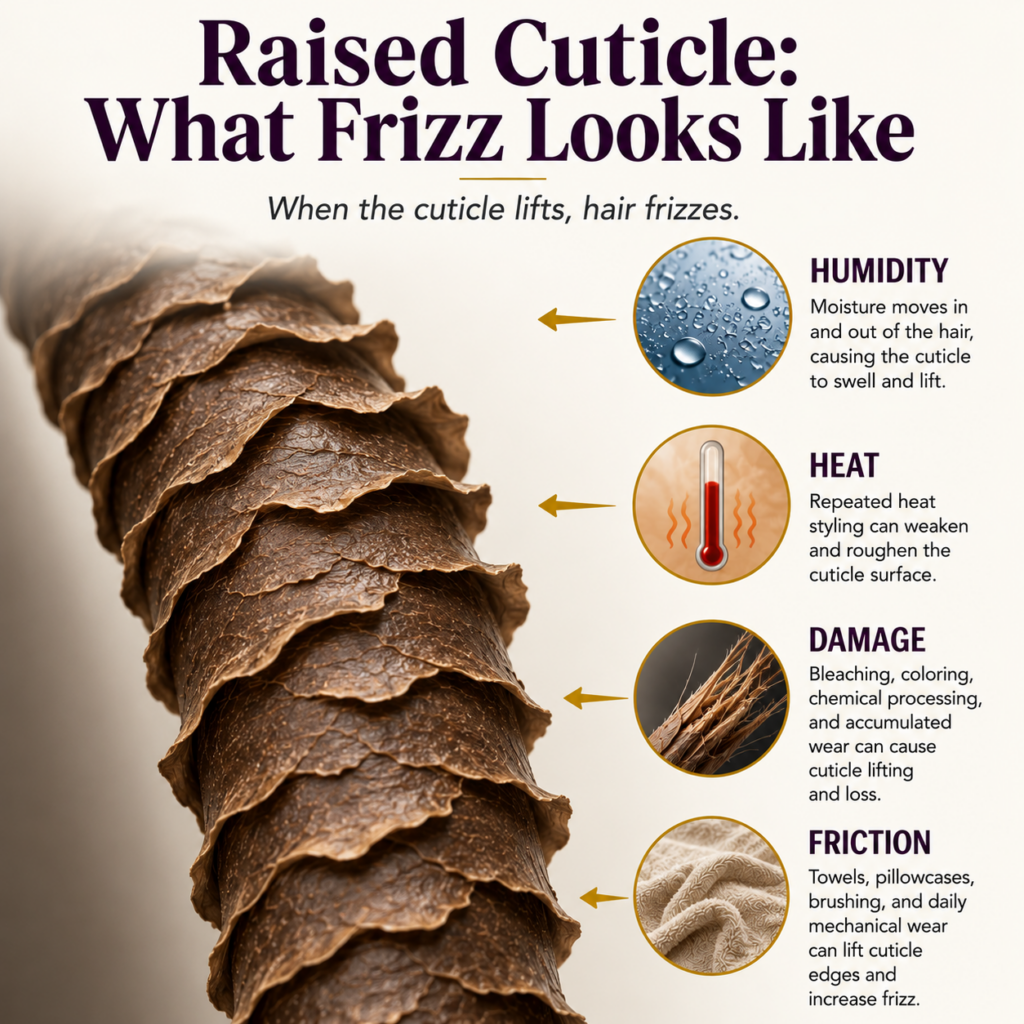
Your hair has an outer layer called the cuticle, made of overlapping scales that lie flat like roof shingles when hair is smooth and healthy. Frizz is what you see when those scales lift instead of lying flat. Raised cuticle, and the strand looks rough, fuzzy, haloed with flyaways.
Humidity is the trigger. Water in the air breaks some of the temporary hydrogen bonds inside the strand, the cuticle lifts, water vapor moves in, and the hair swells unevenly[1]. Curly hair feels this more than straight hair for two reasons: the bends and twists make the cuticle naturally more raised and damage-prone, and the same shape means the strand swells in a way that looks frizzier.
Here is the part that rewires everything. You are not going to win by “adding moisture,” because the air is the moisture. On a humid day there is more water around your hair than any product can add or hold off by hydrating. What actually helps is the opposite move: smooth that lifted cuticle down and lay a thin film over the surface so the air cannot move water in and out so freely[2]. That is what real anti-frizz products do, and it is why the “drink more water for your hair” advice keeps failing you.
Why Curly Hair Frizzes: The Real Causes
Frizz is rarely one thing. It is usually a few of these stacked on top of each other. Find yours here, because the cause points straight at the fix.
Genetics and your texture
Some of this you inherited, plain and simple. Curl pattern and how raised your cuticle naturally sits are largely genetic, so if your mom or grandmother fought frizz, you probably will too. You cannot change that, and you do not need to. It just means frizz is a feature of your texture to work with, not a defect to fix.
Damage (the big one)
This is the cause most within your control, and the one that matters most. Damaged hair has a permanently rougher, more lifted cuticle, so it frizzes far more easily. Bleach, color, heat, harsh handling, all of it wears the cuticle down and leaves the surface raised[3]. A lot of “my hair is so frizzy” is really “my hair is damaged,” and the fix is protecting and not adding to the damage, plus time.
Humidity
Not a flaw in your hair, just weather. Damp air lifts the cuticle and swells the strand, which is why your curls can look perfect indoors and fall apart the second you step outside[1]. You cannot change the weather, but you can build a barrier against it, which is the whole point of the humidity section further down.
Dryness and over-washing (reframed honestly)
Here is where I have to correct the script, including the script I used to repeat. Curly hair is not “thirsty,” and frizz is not your hair crying out for water.
What is true: curly hair’s shape makes it hard for scalp oils to travel down the strand, so the lengths can end up with a rougher, less-conditioned surface that frizzes more[4]. And over-washing with harsh shampoo strips those oils and leaves the surface rough and high-friction.
The fix is not “add moisture,” it is conditioning, smoothing the cuticle with the right agents, and not stripping it in the first place. Same outcome people are chasing, accurate reason.
Not enough hold
Sometimes your curls start defined and then fall apart by noon, frizzing as they lose their shape to wind, friction, and humidity. That is a hold problem, not a moisture problem. A gel or other film-former that sets a cast keeps the cuticle smoothed and the curl clumped through the day.
Technique and the wrong products
Brushing curls dry, skipping conditioner, blasting them with high heat and no protectant, using products built for straight hair, all of it roughs up the cuticle and breaks up the clumps that keep frizz in check. Often the frizz is not your hair at all. It is the routine.
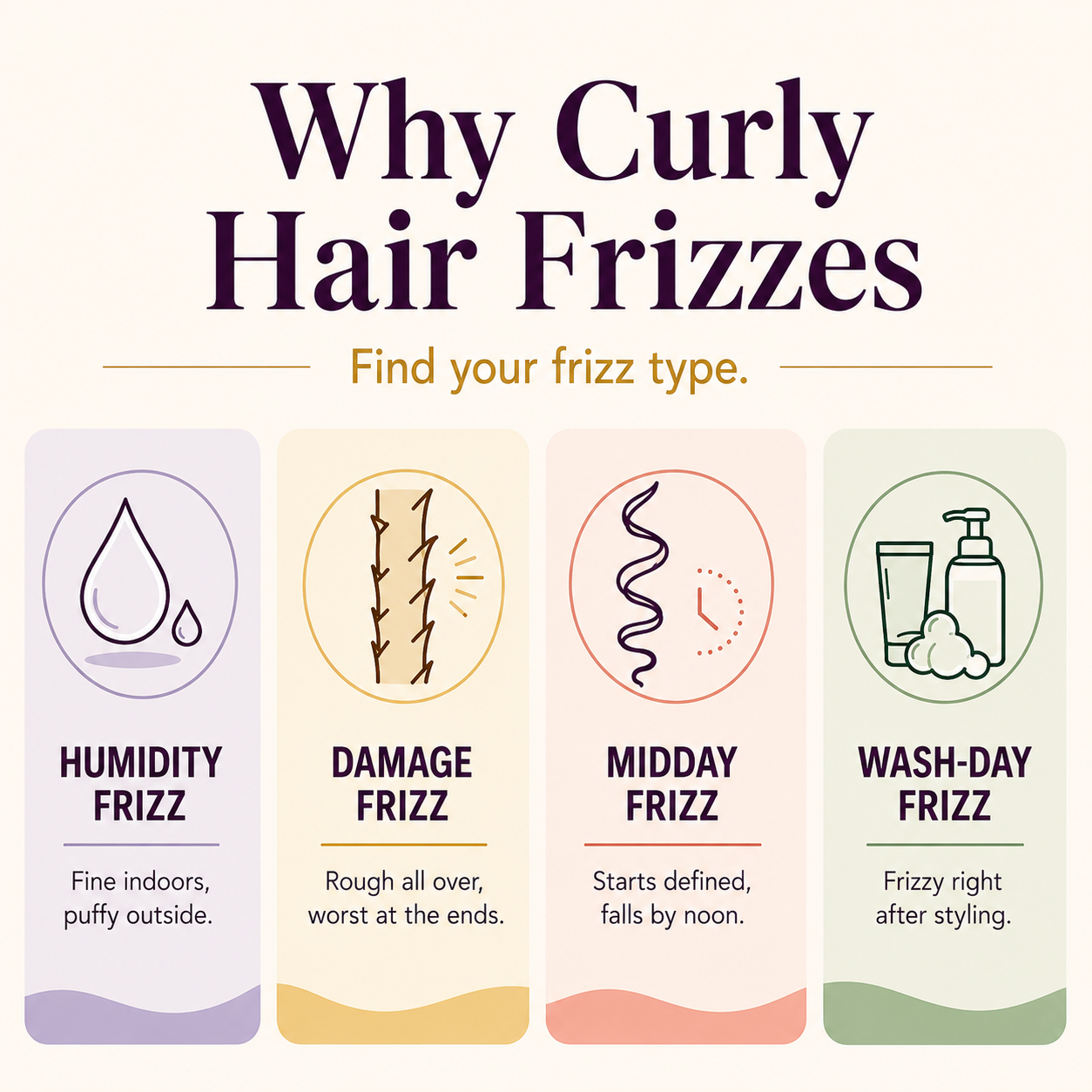
| Quick gut-check: which of the 4 frizz types is yours? – Frizzy only on humid days, fine indoors → humidity; you need a barrier (film-former / gel / anti-humidity styler), not more hydration. – Frizzy and rough all the time, ends worst → damage and a worn cuticle; protect, condition, stop adding damage, give it time. – Starts defined, frizzes by midday → a hold problem; add a film-forming gel and stop touching it. – Frizzy right after wash day → technique or product mismatch; look at how and when you apply, and on what. |
Habits and Factors That Make Frizz Worse
Beyond the big causes, a long list of smaller things nudges frizz up. You do not need to fix all of them, just notice which ones are yours:
- Heat styling without a heat protectant, and water that is too hot.
- Over-washing, or a harsh cleansing routine, that leaves the surface stripped and rough. This is about how often and how aggressively you cleanse, not any single ‘bad’ ingredient; a well-formulated shampoo used at the right frequency is fine.
- Product buildup, including from heavy butters, that leaves curls coated and dull (this washes out with regular shampoo; it is not a reason to fear an ingredient).
- Humectants like glycerin in extreme weather. Humectants attract water, which can help in moderate conditions but in very high humidity may draw more water to the hair and add to swelling and frizz. It’s not that glycerin is bad; it’s that ‘just add glycerin’ isn’t universal advice across every climate.
- Friction from cotton towels, cotton pillowcases, hats, and rough brushing.
- Hard water minerals, chlorine, sun, sweat, and split ends.
- Skipping conditioner, or over-washing that strips the surface.
You will notice I did not say “too much protein” or “protein overload.” That is not a real thing; hair that feels rough or stiff after a protein product is usually under-conditioned, not protein-overloaded. And I did not say to “seal the cuticle with cold water,” because a cold rinse does not meaningfully seal anything. Those two myths get repeated constantly, and dropping them is part of why this guide will actually work for you.
How to Get Frizz-Free Curls: What Actually Works
Now the fixes, grouped by where they happen in your routine. You do not need all of them. Start with the ones that match your kind of frizz from the gut-check above, change one thing at a time, and watch your hair over a few wash days.
In the shower: wash and condition right
- Use a gentle, smoothing shampoo. Sulfate-free, conditioning formulas clean without stripping the surface rough. Options like the Ouidad Defrizzing Shampoo or Jessicurl Gentle Shampoo are solid.
- Condition with intention. Conditioner’s cationic agents lie along the cuticle and smooth it, which is what cuts frizz. Focus on mid-lengths and ends, and and if you prefer, conditioner-only washes between shampoos can be a gentler refresh on the days you don’t need a full cleanse.
- Deep condition regularly. A weekly mask does the same smoothing job with longer contact time, leaving the surface less rough and less frizz-prone. The Jessicurl Deep Conditioning Treatment is a good one.
- Clarify when buildup is the problem. If curls feel coated and dull, regular shampoo usually clears it; a clarifying wash now and then handles stubborn buildup or hard water. You do not need to fear cleansing.
- Skip the cold-water “seal.” Warm, not scalding, water is kinder to the cuticle, but a cold rinse will not meaningfully flatten or seal it, so do not count on that trick.
Out of the shower: style for smoothness
- Style on soaking-wet hair. Apply leave-in and styler while hair is dripping, not damp. Water holds the curl clumps together, and product applied over that wetness locks them in as they dry, which is the single biggest move for frizz-free definition.
- Use a leave-in for slip and smoothing. A lightweight leave-in like the Giovanni Direct Leave-In keeps the surface smooth and detangled so curls clump instead of frizzing.
- Add a film-forming styler for hold. A gel or mousse sets a cast that keeps the cuticle smoothed and the curl shaped all day. Scrunch out the crunch once dry.
- Detangle gently, with product and slip. Use a detangler and a wide-tooth comb / detangling brush or fingers on wet, conditioned hair. The Paul Mitchell Detangler and Briogeo Be Gentle, Be Kind Aloe + Oat Milk Detangling Spray both make this easier.
- Keep your hands off. Touching curls while they dry breaks the clumps and roughs the cuticle. Let them set.
Drying: protect the cuticle
- Swap your towel. A microfiber towel or cotton T-shirt blots water without the friction of a terry towel, which lifts the cuticle and causes frizz.
- Air-dry or diffuse on low. Air-drying is gentlest; if you diffuse, cup sections toward the roots and keep the heat moderate to limit cuticle damage[5]. Flip your head for root volume.
- Always use heat protection. Any dryer, diffuser, or iron gets a heat protectant first; it lays down a barrier that limits the damage that leads to long-term frizz. Curl Keeper Thermal Heat Defense also helps against humidity.
- A better dryer helps. A pro-level dryer with better heat control roughs the hair up less than a cheap one; pair it with a brush suited to your curl type.
Overnight and refresh
- Sleep on silk or satin. Cotton drags and lifts the cuticle overnight; silk or satin pillowcase (or bonnet) lets curls glide, so you wake with less frizz. Satin scrunchies help too.
- Refresh without soaking. Between washes, mist lightly or smooth a little leave-in over the surface rather than rewetting the whole head, then re-scrunch.
- Fix flyaways with a touch of oil, applied smart. A drop of light oil (like Righteous Roots Oils. Use my discount code,Vmuse at checkout to save $) smoothed over the outer layer calms flyaways and adds shine. Less is more, and keep it off the roots.
- Hairspray the smart way. Mist it onto a brush or your palms and smooth over frizzy sections, rather than spraying directly, for control without crunch. Rizos Curls Hairspray or Jessicurl Aquavescent both work.
Work with your frizz, not against it
Some days the air wins, and that is fine. A little frizz and volume is not a failure; it is curly hair being curly hair. On the worst humidity days, reach for forgiving styles (a pineapple, loose braids, an updo) and let your curls live a little. You are not subduing a wild animal. You are working with your own hair.
Frizz Control in Humidity: The Barrier Approach
Humid weather is the real test, and it is where the “add moisture” advice falls apart hardest, because the air already has all the moisture. The move in humidity is to build a barrier the air cannot push through.
The ingredients that actually do this are film-formers and anti-humidity polymers: polyquaternium compounds, PVP and VP copolymers, and yes, silicones like dimethicone, which lie over the cuticle and slow how fast water vapor moves in and out[2]. This is also why a firm-hold gel that sets a cast beats a soft cream on a swampy day.
Let’s talk honestly about silicones
Silicones get treated like villains, and that is mostly marketing, not science. Dimethicone and its cousins are some of the best anti-humidity, cuticle-smoothing ingredients there are; they form a light, even film that fights frizz genuinely well[2]. They are not “sealing in moisture” so much as smoothing the surface and slowing water exchange.
The real considerations are practical, not moral: silicones build up if you rarely shampoo (regular washing removes them), and heavier ones can weigh down fine hair. So you might skip them if you almost never use shampoo, if your hair is fine and easily weighed down, or simply if you do not like how they feel. Otherwise, they are a legitimate tool, not a thing to fear.
About humectants like glycerin
Humectants pull water toward the hair, which sounds great and sometimes is, in mild, moderate weather. But in high humidity a humectant can pull even more water in and swell the strand, making frizz worse. In very dry air it can pull water out. That is why glycerin is not the universal anti-frizz hero it gets sold as; in extreme humidity, lean on the barrier film-formers above instead.
Anti-humidity products worth trying
A mix of fresh-on-the-market and proven staples, all leaning on real film-forming, humidity-blocking chemistry:
The Doux Block Party Anti-Humidity Defining Gel: a newer firm-hold gel built for humid climates, with glycerin, film-forming PVP and copolymers, and a dimethicone-based polymer to block frizz and hold definition for days. Apply to soaking-wet hair in sections and let it cast, then scrunch out.
Miche Beauty Tropical Oasis Anti-Humidity Gel: a firm-hold, silicone-free option using a maltodextrin/VP copolymer film-former with aloe and hydrolyzed quinoa protein; defines and resists humidity for several days, and comes in rotating limited-edition scents of the same formula.
Color Wow Supernatural Spray: an anti-frizz spray that holds up in humidity, good as a light layer over or under other stylers.
Ouidad Advanced Climate Control Heat & Humidity Gel: a strong, proven humidity gel for extremely humid days or curls that want more structure.
Living Proof No Frizz Instant De-Frizzer: a dry, between-wash spray for flyaways that will not lie down, handy in humid weather.
Virtue Un-Frizz Cream: a smoothing cream that holds humidity at bay through the day.
More Frizz-Fighting Products by Job
What works depends on your hair (porosity, how much oil your scalp makes, your curl pattern), so think in terms of the job each product does rather than chasing one hero product. Here are staples worth knowing, grouped by role. Described by what they do, not by marketing.
Smoothing serums and oils (flyaways, shine, a surface barrier)
John Frieda Frizz Ease Extra Strength Serum: a silicone blend that smooths and shields against frizz; skip if you avoid silicones.
Moroccanoil Treatment: a little smooths frizz and adds shine; a longtime staple.
CURLSMITH Frizz Rescue Finishing Serum a serum that smooths flyaways and helps detangle.
OUAI Anti Frizz Cream: frizz control for up to 72 hours that also smooths the surface and shields against heat.
Leave-ins and styling milks (slip and surface smoothing)
Carol’s Daughter Monoi Multi-Styling Milk: a styling milk that smooths and supports definition with less breakage.
It’s a 10 Miracle Leave-In: a multi-tasking leave-in that smooths and adds heat protection.
Redken Extreme Anti-Snap Leave-In: a strengthening leave-in for fragile, breakage-prone hair, which helps the surface frizz less.
Bounce Curl Moisture Balance Leave-In: a lightweight leave-in / primer (note: described by role, not the “balance” marketing in the name).
Creams and mousses (definition with frizz control)
It’s a 10 Miracle Curl Defining Cream: a cream made for frizzy, curly hair that boosts definition.
SheaMoisture Coconut & Hibiscus Curl Mousse: a mousse that enhances curl memory and adds definition with frizz control.
Kenra Volume Mousse: softens and smooths the cuticle while conditioning and adding thermal protection.
NaturAll Avocado Curl Custard: a medium-hold styler, silicone- and sulfate-free if that is your preference.
Shampoos, conditioners, and masks (the smoothing foundation)
Bumble and bumble Hairdresser’s Invisible Oil Shampoo: a gentle cleanser for dry, brittle hair using a blend of conditioning oils.
Bouclème Curl Cleanser: a gentle, low-foaming curl shampoo that cleans without leaving the surface rough, so curls clump and frizz less.
Tresemmé Keratin Smooth Shampoo & Conditioner: budget duo that smooths the cuticle as it cleanses and conditions.
SheaMoisture Manuka Honey & Mafura Oil Intensive Hydration Mask: a rich conditioning mask for dry, damaged hair that smooths and softens (used for conditioning, not “follicle strengthening”).
Finishing and humidity touch-ups
Briogeo Farewell Frizz Blow Dry Perfection Heat Protectant Cream: lightweight heat protection that smooths and shields up to 450°F.
Bounce Curl Hair Spray: genuinely strong in humidity; a little before heading out goes far.
Oribe Foundation Mist: anti-static finishing mist that keeps hair from going staticky after blow-drying.
Frizzy Curly Hair FAQ
Is frizzy hair just dry hair?
Not exactly. Frizz is a raised cuticle letting humidity in and out unevenly. Dryness and damage make the cuticle rougher and more frizz-prone, so they are related, but the fix is smoothing and protecting the surface, not pouring water at it.
How do I stop my curly hair from frizzing in humidity?
Build a barrier the damp air cannot push through: a film-forming or anti-humidity gel (look for polyquaternium, PVP/VP copolymers, or dimethicone), applied to soaking-wet hair and set into a cast, then scrunched out. Skip heavy humectants like glycerin on very humid days, since they can pull in more water and worsen frizz.
Are silicones bad for frizzy curly hair?
No. Silicones like dimethicone are among the best anti-humidity, cuticle-smoothing ingredients there are. They wash out with regular shampoo. Skip them only if you rarely shampoo, if your hair is fine and easily weighed down, or if you dislike how they feel.
Does cold water stop frizz?
Not meaningfully. A cold rinse does not truly seal the cuticle. Warm (not hot) water is kinder to the surface, but your frizz control comes from conditioning, smoothing, and film-formers, not water temperature.
Can I get rid of frizz permanently?
No, and that is not the goal. Frizz is part of having a curly texture and it responds to weather. You can reduce it dramatically and consistently by protecting the cuticle, conditioning, and using the right barrier products, but some humidity-day frizz is normal, not a failure.
The Bottom Line
Frizz is not your curls misbehaving and it is not a sign you are doing something wrong. It is a raised cuticle meeting humid air, full stop. Once you see it that way, the contradictory advice falls away and the real fixes line up: smooth and protect the cuticle, condition instead of stripping, lay a barrier against humidity, and stop fighting your hair into something it is not. Start with the kind of frizz you actually have, change one thing at a time, and let your curls show you what works. They will.
References
- Robbins CR. Chemical and Physical Behavior of Human Hair. 5th ed. Berlin: Springer; 2012. (Humidity, hydrogen bonds, cuticle lifting, and swelling.)
- Gavazzoni Dias MFR. Hair cosmetics: an overview. Int J Trichology. 2015;7(1):2–15. (Film-formers, silicones, and conditioning agents smoothing the cuticle and resisting humidity.)
- Monselise A, Cohen DE, Wanser R, Shapiro J. What ages hair? Int J Womens Dermatol. 2015;1(4):161–166. (Damage, weathering, and a roughened cuticle.)
- @sciencemeetscosmetics, on “moisture” as conditioning rather than water content, and curly hair’s slower sebum distribution (Instagram educational series).
- Lee Y, Kim Y-D, Hyun H-J, Pi L, Jin X, Lee W-S. Hair shaft damage from heat and drying time of hair dryer. Ann Dermatol. 2011;23(4):455–462.
For Further Reading
- Bouillon C, Wilkinson J. The Science of Hair Care. 2nd ed. Boca Raton: CRC Press; 2005.
- Gavazzoni Dias MFR, et al. The shampoo pH can affect the hair: myth or reality? Int J Trichology. 2014;6(3):95–99.