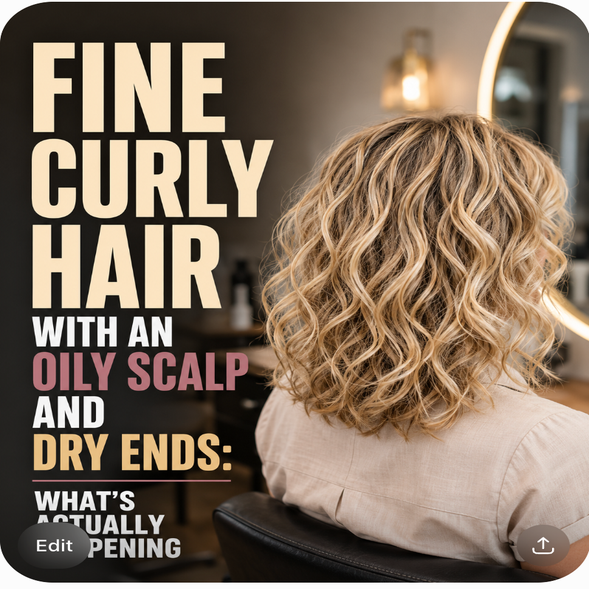
Your hair falls in loose waves one morning and springs into defined ringlets the next. That is the maddening, wonderful truth about 3A curls: they rarely behave the way the chart says they should.
I have spent years writing about curls, but my fastest education happened at home. Two of my kids have 3A hair, and between wash days, humidity swings, and every “holy grail” product we have tried on them, I have watched exactly how loose spiral curls behave in real life, not just in stock photos.
To make sure the science here is accurate and not just copied from other blogs, I went through all of it with my friend, a hair scientist and cosmetic formulator with a PhD in chemistry.
Here is what makes this guide different. Almost every 3A article online tells you the same thing: your curls are dry, so soak them in moisture and reach for the most hydrating products you can find. That advice is mostly backwards, and it is the reason so many 3A curls end up limp, coated, and frustrating. Loose curls are rarely starving for moisture. They are usually carrying too much weight and not enough hold.
Below, you will learn how to confirm whether you actually have 3A hair, how to tell it apart from 2C and 3B, why your pattern shifts day to day, and how to build a routine around what loose spirals truly need.
Short answer: 3A hair is the loosest curl type, soft spiral ringlets roughly the width of a piece of sidewalk chalk. To confirm it, look at your hair clean, dry, and free of heavy product: full spirals point to 3A, stretched S-waves point to 2C. And the part most guides miss is that 3A is not a moisture problem to fix; it is a weight-and-hold balance to dial in.
What Is 3A Hair?
3A hair forms loose, springy spiral ringlets about the width of a piece of sidewalk chalk or a large marker.
Type 3A is the first and loosest of the curly (type 3) patterns. The curls are larger and more open than 3B or 3C, but they form visible, rounded ringlets rather than the stretched S-waves of wavy hair. That places 3A right on the border between 2C waves and tighter type 3 curls, which is exactly why so many people second-guess where they land.
In real life, 3A tends to be fine to medium in strand thickness, shiny when healthy, and full of natural lift and bounce. It also reacts quickly to weight and weather: heavy creams, oils, or buildup can flatten the spirals, while humidity can puff them out or soften their shape.
One more thing worth knowing early: 3A rarely looks uniform across your whole head. Looser pieces near the crown with tighter spirals underneath is completely normal, not a sign you are doing something wrong.


How Do You Know If You Have 3A Hair?
The most reliable way to see your true pattern is to look at clean, dry hair that is not weighed down by heavy product or buildup.
Wet hair is a trap for curl typing. When your hair is soaked, water temporarily resets the hydrogen bonds inside each strand, so curls relax and look looser and wavier than they really are. As the hair dries, those bonds re-form and your true pattern reappears. So always judge your curl type on dry hair, not in the shower.
A simple at-home check is the curl-size test. Take a single dry curl and see what it wraps around best: a piece of sidewalk chalk points to 3A, a permanent marker to 3B, and a pencil to 3C. If your hair feels coated or stretched, clarify first, then re-check on a clean wash day.
Look at where most of your head lands, not the single loosest or tightest piece. And do not brush it out before you look; brushing breaks the curl clumps apart and can make spirals read as waves.
Is My Hair 2C or 3A?
If it forms full spirals you could slide a finger through, it is 3A; if it makes stretched S-waves that lie flatter, it is 2C.
2C is the waviest type 2 pattern. It makes strong, defined S-shaped waves that often start near the roots, sometimes with a few loose spirals around the face or underneath. The key tell is that 2C stays more elongated; it does not coil all the way around itself.
3A makes consistent ringlets that spring upward and hold a rounded shape from root to tip. After a wash with lightweight product, left to dry without brushing, 3A keeps its spiral; 2C tends to drop back into waves.
If you see waves at the crown and spirals underneath, you are not failing the test. Mixed texture is extremely common, and many heads are genuinely 2C in some sections and 3A in others. Treat the label as a starting point for choosing product weight, not a rule you have to obey.
What Is the Difference Between 3A, 3B, and 3C Hair?
All three are curly; the difference is curl diameter, with 3A the loosest and 3C the tightest.
3A curls are the largest and most open, about the width of sidewalk chalk. 3B curls are tighter and springier, closer to the width of a marker, with more volume and frizz. 3C curls are tighter still, corkscrew spirals around the width of a pencil, with the most shrinkage and density of the three.
These are useful labels for picturing your pattern, but they sit on a spectrum and they do not, on their own, decide your routine. For how every curl type fits together, see our complete guide to curly hair types. More on what actually decides your routine below.
Why Does Your Curl Pattern Look Different Every Day?
Your pattern is not broken or inconsistent; it shifts with water, weight, and weather, because the hydrogen bonds inside the strand reset every time your hair gets wet and dries.
The biggest day-to-day variable is humidity. The amount of water a strand holds is set mostly by the moisture in the air around it, not by the products you apply[1]. On a humid day, strands take on more water, swell slightly, and frizz or puff; on a dry day they hold their shape more tightly. That is environment, not your hair changing type.
Weight and buildup do the rest. Heavy stylers, oils, leftover product, and hard-water minerals all pull loose curls down, so an otherwise springy 3A can read as a stretched 2C until you clarify. Your haircut matters too: length and bulk near the ends can drag spirals into waves.
So when your curls look “looser” one day, the usual culprits are humidity, product load, or a wash that is overdue, not a change in your actual curl pattern.
What Actually Determines Your Curl Pattern?
Your curl pattern is set at the follicle, not by your products, your porosity, or how “dry” your hair is.
Curl is built into the hair before it ever leaves your scalp. Research shows that curliness is programmed in the follicle bulb, driven by the curvature of the follicle and the asymmetric way cells grow and keratinize as the fiber forms[2]. The hair fiber is essentially a shape-memory material; a curvy follicle keeps producing curvy hair.
This corrects a common myth. You will often read that a round follicle makes straight hair and an oval one makes curls, full stop. The shape of the cross-section plays a role, but it is really the follicle’s curvature and that asymmetric cell growth that drive curl; a straight follicle can grow straight hair even when the cross-section is elliptical.
Inside the strand, the structure follows suit. Curly hair is more elliptical than straight hair, and the cortex, the thick middle layer, is built from two cell types: ortho-cortical and para-cortical. When those cells sit unevenly, with more para-cortical cells weighted to one side, the fiber is pulled into a tighter, more elliptical curl; a more even distribution reads as straighter hair[3]. This is the structural reason a curl holds its shape: it is built into the fiber, not applied from a bottle.
It is also worth retiring the line that “curly hair is just dry hair.” Sebum spreads less evenly along a curved fiber, and the ends are simply older and more worn, so curly lengths can feel drier. But the fix is conditioning that smooths the cuticle surface, which is what gives that soft, conditioned feel[4]; it is not about forcing water into the strand.
Does Your Curl Type Decide Your Products?
No. Two people with identical 3A curls can need completely different routines, because curl shape is only one variable.
What actually steers your product choices is strand thickness, density, how easily your hair is weighed down, your climate and water, and the condition of your cuticle. That last one is porosity, and porosity is a spectrum and a damage indicator, not a fixed type you are born with and match products to forever[5].
In practice: fine 3A fights flatness and shows buildup fast, so it does best with lightweight products and regular clarifying. Coarser or thicker 3A can carry richer creams without collapsing. Same curl pattern, opposite routines.
This is why copying someone’s exact routine off Instagram so often flops, even when their curls look just like yours. Use your curl type to picture your hair, then choose products by weight and behavior, not by the number on a chart.
What Does 3A Hair Actually Need?
Loose 3A curls are rarely short on moisture; they are usually short on hold and carrying too much weight.
The popular advice runs like this: 3A thrives on moisture, so layer on rich hydrating creams and deep condition often. It gets the problem backwards. A strand’s water content is set mostly by the surrounding humidity, not by how much product you pile on[1], and the soft “moisturized” feel you get from a good conditioner is conditioning agents smoothing the cuticle surface, a temporary feel, not water driven into the strand[4].
For loose curls, the two levers that actually change your result are weight and hold. Lighter products keep spirals from collapsing under their own coating; heavy oils and butters form a film that sits on the surface and drags the pattern down[6]. Hold is what most 3A routines are missing: a flexible-to-firm gel or mousse sets the curl into a cast as it dries, then you scrunch the cast out for soft, defined, lasting spirals.
So the order of operations for 3A is weight first, hold second, conditioning for slip and feel, and “moisture” almost never as the goal. Get those right and the dryness and frizz most people chase tend to settle on their own.
How Often Should You Wash 3A Hair?
Wash when your scalp needs it, not on a fixed “once a week to save moisture” schedule.
The real driver of wash frequency is your scalp (oil, sweat, and product), not your curl type. Many 3A heads land somewhere between every few days and once a week, but treat that as a starting point and adjust to how your scalp feels, not a rule for the whole curl type.
With loose curls, under-washing backfires fast: buildup and oil at the roots flatten 3A spirals and dull their bounce. Keep the lather on your scalp and let the suds rinse through to clean the lengths. And you can skip the cold-water-rinse step; cold water does not seal the cuticle or lock anything in, so wash at whatever temperature is comfortable.
How Do You Style 3A Hair for Definition and Hold?
Style on soaking-wet hair, use enough hold to set a cast, then leave it alone while it dries.
Loose curls clump best when they are very wet and carrying a gel or styler that can set. The mistakes that wreck 3A are almost always about timing and touching, not about needing more product.
- Apply on soaking-wet hair. Water helps the spirals clump together; raking or scrunching product through wet hair encourages even, defined curls.
- Use real hold. A flexible-to-medium gel or mousse forms a cast as it dries that holds the curl shape. Once fully dry, scrunch the crunch out for soft, defined spirals.
- Plop or diffuse for lift. Plopping into a cotton tee or microfiber towel and diffusing on low heat both add root volume; air drying gives softer, looser results.
- Stop touching it. Handling curls while they dry breaks the clumps apart and creates frizz. Set them, then keep your hands off until dry.
- Refresh, do not reload. On day two and beyond, revive curls with water and a little leave-in or foam, not another layer of cream; here is how to refresh curls between washes. Change one thing, then give it a few wash days before you judge whether it worked.
What Are the Best Products for 3A Hair?
Pick by the job and the weight, not by whether the bottle says “hydrating.” Loose 3A curls do best with lightweight cleansing, slip from your conditioner, and enough hold to set the shape. The picks below are grouped by job; fine 3A should lean to the lighter options, while thicker or coarser 3A can handle the richer ones.
What Are the Best Haircuts and Styles for 3A Hair?
The best cuts give loose curls shape and lift without leaving heavy, stretched-out length at the bottom.
Haircuts That Work for 3A
- Layers. Soft layers remove weight so curls lift and separate instead of forming a flat, triangular shape near the ends.
- Shoulder-length cuts. A medium length balances volume and definition without long ends dragging the spirals down.
- Curly lob. Keeps enough length for visible spirals while building shape and fullness through the mid-lengths.
One caution for fine 3A: over-thinning can leave wispy, see-through ends. Whenever possible, have curls cut dry and curl by curl so your stylist can shape the pattern you actually wear.


Easy Styles for 3A
- Textured top knot. Loosely gather, twist, and pin at the crown, leaving a few curls out around the face. Great for second- or third-day hair.
- Half updo. Keeps volume at the crown while showing the curl pattern; dress it up with a clip or scarf.
- Low ponytail. Simple and quick; mist with a flexible-hold spray first to keep the length defined.
Common 3A Hair Mistakes to Skip
Most 3A frustration traces back to a handful of myths worth letting go of:
- Chasing “moisture” instead of hold, then wondering why curls fall flat by midday.
- Reaching for heavy creams, butters, and oils that coat loose spirals and weigh them down.
- Skipping clarifying, so buildup quietly stretches and flattens the pattern.
- Matching products to a fixed porosity “type” instead of choosing by weight and behavior.
- Brushing dry curls or touching them constantly while they set, which breaks clumps and adds frizz.
- Finishing with a cold-water rinse to “seal” the cuticle; it does not seal anything.
- Adding protein to “rebalance” the hair; there is no moisture-protein balance to manage.
3A Hair FAQ
Is 3A hair curly or wavy?
Curly. 3A is the first and loosest of the curly (type 3) patterns. It forms full spiral ringlets, where 2C, the waviest type 2 pattern, makes stretched S-waves that do not fully coil.
How do I know if I have 2C or 3A?
Look at clean, dry, product-light hair. If it forms rounded spirals you could slide a finger through, it is 3A; if it lies flatter in S-waves, it is 2C. Mixed sections are common and completely normal.
Why does my 3A hair fall flat or lose its curl?
Usually weight or buildup, not a lack of moisture. Heavy products, leftover residue, hard-water minerals, and an overdue wash all drag loose curls down. Lighten your products, clarify, and add a flexible-hold gel or mousse to set the shape.
How often should I wash 3A hair?
As often as your scalp needs, commonly every few days to about once a week, adjusted to your oil, sweat, and product use. For loose curls, under-washing usually causes more flattening than over-washing.
Does 3A hair need protein?
Not as a rule. Some hydrolyzed protein can temporarily help worn or heat-stressed spots and improve spring, but it is one conditioning agent among many, not a separate “moisture balance” to manage. If your hair feels stiff, you are likely using more than you need.
What products should I avoid for 3A hair?
There is no ingredient to fear; it is about weight. Heavy butters and rich creams that flatten loose spirals are the main thing fine 3A should use sparingly. Choose by how light or heavy a product feels on your curls, not by a “free-from” label.
Can 3A hair be low or high porosity?
Yes. Porosity describes the condition of your cuticle on a spectrum, not a fixed type tied to your curl pattern. Smooth, healthy 3A often sits on the lower-porosity end where product can build up, while bleached or heat-stressed 3A behaves more like high porosity.
Loose curls are forgiving once you stop fighting them. Lighten up, add real hold, clean your scalp on its own schedule, and let your spirals do what they were programmed to do.
References
[1] Wolfram, L. J. (2003). Human hair: a unique physicochemical composite. Journal of the American Academy of Dermatology, 48(6 Suppl), S106-S114. (Hair water content tracks ambient humidity.)
[2] Thibaut, S., Gaillard, O., Bouhanna, P., Cannell, D. W., & Bernard, B. A. (2005). Human hair shape is programmed from the bulb. British Journal of Dermatology, 152(4), 632-638.
[3] Cloete, E., Khumalo, N. P., & Ngoepe, M. N. (2019). The what, why and how of curly hair: a review. Proceedings of the Royal Society A, 475(2231), 20190516. (Cortical cell-type distribution and fiber ellipticity shape the curl.)
[4] Bhushan, B. (2008). Nanoscale characterization of human hair and hair conditioners. Progress in Materials Science, 53(4), 585-710. (Conditioning agents smooth the cuticle surface.)
[5] Syed, A. N., & Ayoub, H. (2002). Correlating porosity and tensile strength of chemically modified hair. Cosmetics and Toiletries, 117(11), 57-64. (Porosity reflects cuticle condition and damage.)
[6] Keis, K., Persaud, D., Kamath, Y. K., & Rele, A. S. (2007). Investigation of penetration abilities of various oils into human hair fibers. Journal of Cosmetic Science, 58(4), 379-386. (Most oils form a surface film.)
Keep Reading
- Curly Hair Types: The Definitive Guide
- How to Care for 3B Hair: A Comprehensive Guide
- 3C Hair: Comprehensive Care Guide
- How to Refresh Your Curls Between Washes
- 25 Best Shampoos for Curly Hair
- Hair Porosity 101
- Wavy Hair: The 2A, 2B, and 2C Routine Guide
- Best Gels for Curly Hair
- How to Establish a Curly Hair Care Routine
- 24 Best Curl Creams for Curly Hair (for Every Texture and Porosity)
- Best Leave-In Conditioners for Curly Hair (By Curl Concern)