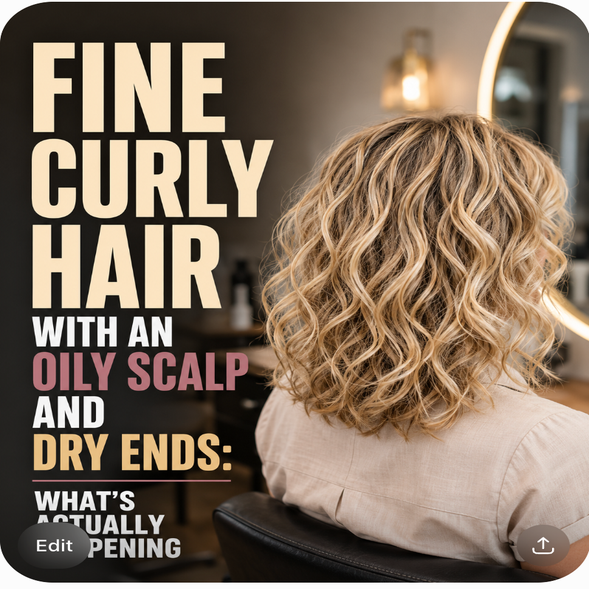
Flat roots are one of the most common curly hair frustrations: defined curls through the lengths, but a crown that lies flat against your scalp. I have chased root volume on my own hair for years, and I worked through the why with my friend, a hair scientist and cosmetic formulator with a PhD in chemistry, so these techniques are sorted by what actually moves the needle, not just a list of everything.
The short version: root volume comes mostly from technique, not a single magic product. Combine lightweight products at the crown, wet-styling tricks (especially styling upside down), root-lifting methods like clipping and diffusing, and overnight protection. One principle ties it together: aim to make your roots match the volume through the rest of your hair, so you do not end up with full lengths sitting under a flat top.
Quick Fixes for Flat Roots (Start Here)
If you want a fast win before reworking your whole routine, start with these five:
- Diffuse while drying to lift the roots.
- Apply mousse or a light root-lifter at the crown, not heavy cream.
- Keep heavy creams and oils away from the scalp.
- Clip your roots while your hair dries.
- Style and dry upside down, and switch your part.
Below are all 20 techniques, grouped by what they do so you can build from the foundation up rather than trying everything at once. Where a technique buys volume at the cost of some curl definition, I have flagged it so you can choose with eyes open.
Start With the Foundation: Cut and Curl Type
1. Get a Haircut
It seems backward, but as hair gets longer the added weight pulls curls down and flattens the roots. You do not need a big chop; removing a few inches can lighten the hair enough to create natural lift. That said, a cut alone will not fix flat roots; if the flatness continues, it is usually technique, buildup, or products that are too heavy for your curl type.
2. Add Layers (Carefully)
Layers can create lift and movement, but keep them minimal: too many can make hair look thin or stringy, and on fine hair a single-length cut can actually look thicker. On longer hair, layers shape more than they lift at the root. Talk to a curly-hair stylist about the right layering for your length, density, and pattern.
3. Work With Your Curl Type
Sometimes the crown is not lacking volume, it is simply your natural pattern: on many curl types the curl forms lower down the strand, so the roots read flatter while the lengths coil[1]. That is genetics, not a mistake. The move is not to fight it but to encourage lift at the roots with the right technique and lightweight product. You can learn your texture here.
Build Volume While Styling Wet
4. Style While Wet
Wet hair is moldable and holds the shape it dries in, so styling wet is one of the easiest ways to build root volume[2]. Shape lift in from the start (braids, the pineapple, curl rods, or simply lifting sections as you apply product), and the hair keeps that structure as it dries. A little mousse or light gel locks it in.
5. Rinse and Style Upside Down (and Switch Your Part)
This is the technique the best root-volume guides swear by, and it is nearly free. Flip your head forward and rinse your conditioner out upside down, then apply your stylers with your head still flipped, tossing side to side. You are training the hair to set lifted, so when you flip it back upright the roots stand up instead of lying flat[2].
The companion trick: dry your hair parted on the opposite side from where you actually wear it (or with no part), then flip to your real part once dry. Hair styled on its natural part tends to fall flat there, even with clipping, so setting it against the part builds in lift.
6. Section Your Hair
Working in smaller sections lets you target lift exactly where you need it, and smaller sections dry faster, which helps the volume set before it can collapse. This pairs well with clipping and diffusing.
Use Lightweight Products at the Roots
7. Go Light on Product at the Roots
Too much product, especially heavy creams and oils near the scalp, weighs roots down and kills volume, and it can build up into a coated, greasy-looking crown[3].
Use minimal product at the roots (especially on fine hair), focus application from the mid-lengths to the ends, then lightly sweep any leftover product upward without adding more.
Gel tip: do not rake gel through the roots; scrunch a small amount in instead, which boosts volume and avoids a stringy, flattened finish.
8. Choose Root-Friendly Products
Be intentional at the roots: look for lightweight formulas that lift without weighing hair down (labels like “volumizing” or “root lift”). A root-booster spray is a good option for height at the crown. A few to try:
K18 AstroLift Volumizing Spray. A lightweight spray that lifts flat roots without leaving curls stiff or sticky; it uses flexible styling polymers rather than drying alcohols or crunchy fixatives, so curls still clump and move.
Great for fine or low-density curls and crowns that collapse after wash day. Apply to damp roots before diffusing, lifting sections up with fingers or clips; it can also be misted lightly on dry second- or third-day roots.
Bumble and bumble Surf Spray (a definition tradeoff). A salt spray that adds gritty texture and separation, which reads as fuller, more tousled hair and loosens tight clumps. Worth being honest: salt sprays add grip and can be drying with repeated use, and they trade some smooth curl definition for that piecey volume, so use sparingly and follow with conditioning if your curls feel rough.
Innersense Inner Peace Whipped Creme Texturizer. A lightweight texturizer that creates separation and definition with a soft, flexible, pomade-like hold, good for movement without weighing hair down.
Ouidad Going Up Volumizing Texture Spray. A light spray-gel that adds volume and definition without stiffness, effective on fine hair and usable between washes as a refresher.
Living Proof Full Root Lifting Spray. A heat-activated spray that protects against heat while lifting the roots without a tacky feel, for soft, natural volume right at the base.
Jessicurl Gelebration Spray. Made with fine hair in mind, using ingredients like flaxseed and glycerin to add body and lightweight hold.
Paul Mitchell Extra-Body Boost Volumizing Spray. A vegan volumizing spray for lift on fine hair; mist close to damp roots while lifting sections, then dry as usual.
9. Use Mousse
Mousse is underrated for root volume: it holds shape and gives bouncy, defined curls without the weight of a cream. Apply to damp hair, style as usual, and diffuse for extra lift. If a mousse feels heavy, switch to a lighter foam.
Dry for Lift
10. Diffuse
Diffusing dries curls gently while adding lift and definition. Cup sections up toward the roots as you dry, and on fine hair start on low heat and increase only if needed; keeping the heat moderate protects the strand[4].
11. Air-Dry
Air-drying keeps your natural pattern intact and avoids heat entirely. Diffusing adds more lift, but air-drying gives the most natural shape and flow if you have the time. Lifting and clipping the roots while they air-dry helps the volume hold.
Watch the air-drying technique in action below.
12. Root Clipping
Clipping lifts the roots as they dry so they set with height instead of flat against the scalp. After applying product to wet hair, take small sections at the crown, lift straight up, and clip at the base with alligator styling clips or duckbill clips; leave them until fully dry. It pairs well with a light-hold spray and is one of the highest-impact tricks here.
13. Define With a Denman Brush
A Denman-style brush helps shape curls and lift them at the roots, improving both definition and volume. Used gently from roots to tips, it gathers strands into cleaner clumps. See the detailed Denman brush guide for technique.
Protect and Refresh Your Volume
14. Preserve Volume While You Sleep
Curls lose shape and root lift overnight from being pressed against a pillow. Protecting your hair at night (a satin or silk surface, and a loose set style) keeps the crown from flattening, so you refresh less in the morning.
15. Wear a Pineapple
The pineapple preserves root volume: flip your head upside down, gather hair loosely at the very top, and secure with a satin scrunchie or TELETIES. It keeps roots from flattening overnight, and a 20 to 30 minute daytime pineapple can revive a flat crown on day two or three
16. Clarify to Remove Buildup
Product and mineral buildup weighs hair down and shrinks volume, so periodic clarifying resets the roots, much like exfoliating clears the skin[5]. Buildup is formula-dependent and washes out[3]; regular shampoo handles most of it, with a clarifying wash reserved for stubborn heaviness or hard water.
17. Refresh With Dry Shampoo
Dry shampoo is a quick volume boost when roots fall flat between washes; it absorbs excess oil and adds grip at the crown. Useful mid-week, especially if oil at the roots is part of what is weighing them down.
18. Set Roots With a Light Hairspray
A light mist of hairspray at the roots after styling helps hold lift and resist flattening through the day. Pair it with a root-lifter or mousse underneath for more staying power.
Quick Lift That Trades Some Definition
These target the root directly and add fast height, but they break up curl clumps to do it, so you trade a little definition for air and volume. Great in a pinch; just know the tradeoff.
19. Pick Out the Roots
A hair pick lifts the under-layers at the scalp for instant height. Lift sections and gently pick the hair underneath close to the roots, avoiding the top layer so your surface curls stay defined. This does disrupt curl clumping at the root, which is exactly what creates the airy lift.
20. Fluff With Your Fingers
The gentler cousin of picking: gently separate and lift at the roots with your fingers (or a wide-tooth comb) to add height. It disturbs the clumps less than a pick, so it is a softer way to revive volume without fully sacrificing definition.
Final Thoughts: Building Lasting Root Volume
Flat roots are rarely fixed by one trick; it is the combination that works: a cut that removes weight, lightweight products at the crown, and styling and drying methods that set the roots lifted, especially styling upside down and clipping.
Start by clearing any buildup and switching to lighter formulas, then layer in the techniques that keep your definition before reaching for the ones that trade it. Find the mix that suits your hair type, stay consistent, and your routine gets faster and more predictable. Save this guide so you can test techniques and build your ideal routine.
References
- Gavazzoni Dias MFR. Hair cosmetics: an overview. Int J Trichology. 2015;7(1):2–15. (Curl pattern, follicle shape, and how curl forms along the strand.)
- Robbins CR. Chemical and Physical Behavior of Human Hair. 5th ed. Berlin: Springer; 2012. (Wet hair is moldable; hydrogen bonds reform on drying, so hair holds the shape it dries in.)
- @sciencemeetscosmetics, on product build-up as formulation-dependent (sebum, oils, styling polymers) and removable by regular washing (Instagram educational series).
- Lee Y, Kim Y-D, Hyun H-J, Pi L, Jin X, Lee W-S. Hair shaft damage from heat and drying time of hair dryer. Ann Dermatol. 2011;23(4):455–462. (Keeping heat moderate protects the strand.)
- Draelos ZD. Essentials of hair care often neglected: hair cleansing. Int J Trichology. 2010;2(1):24–29. (Cleansing and buildup removal.)
For Further Reading
- Bouillon C, Wilkinson J. The Science of Hair Care. 2nd ed. Boca Raton: CRC Press; 2005.