Fact Checked & Reviewed By Leonela Paladino
Leo has more than 17 years of valuable experience as a researcher and lecturer in the Biology and Genetics field. Holding a PhD in Biology…
For years, many of us in the curly hair community leaned on observation, trial, and shared experience to make sense of our hair. We learned to test our porosity by dropping a strand in a glass of water, sorted ourselves into low, medium, or high, and then chased the products that were supposed to match our type.
The frustration was real. What we often lacked was the language to describe what was actually happening on the surface of the hair fiber.
Over time, I started noticing that a lot of the porosity advice circulating online did not line up with what cosmetic chemistry actually shows about the cuticle, damage, and how water moves through hair. So I went to the source. I reached out to my friend, a hair scientist and cosmetic formulator with a PhD in chemistry, and asked her to walk me through it.
One thing became clear quickly: the community observations were valid, but the explanations were often simplified or pinned to the wrong cause. Porosity is not a fixed personality you are born with and keep for life. It is a reflection of the condition of your cuticle, and it shifts as your hair is damaged or protected. The popular float test does not measure it reliably. And many of the rituals we were told to build around our porosity type, from clarifying every week to apple cider vinegar rinses, do not hold up the way we thought.
The goal of this guide is not to dismiss what you have experienced. It is to look at what the research says about the cuticle, damage, and conditioning, so you can stop guessing at a label and start reading what your own hair is telling you.
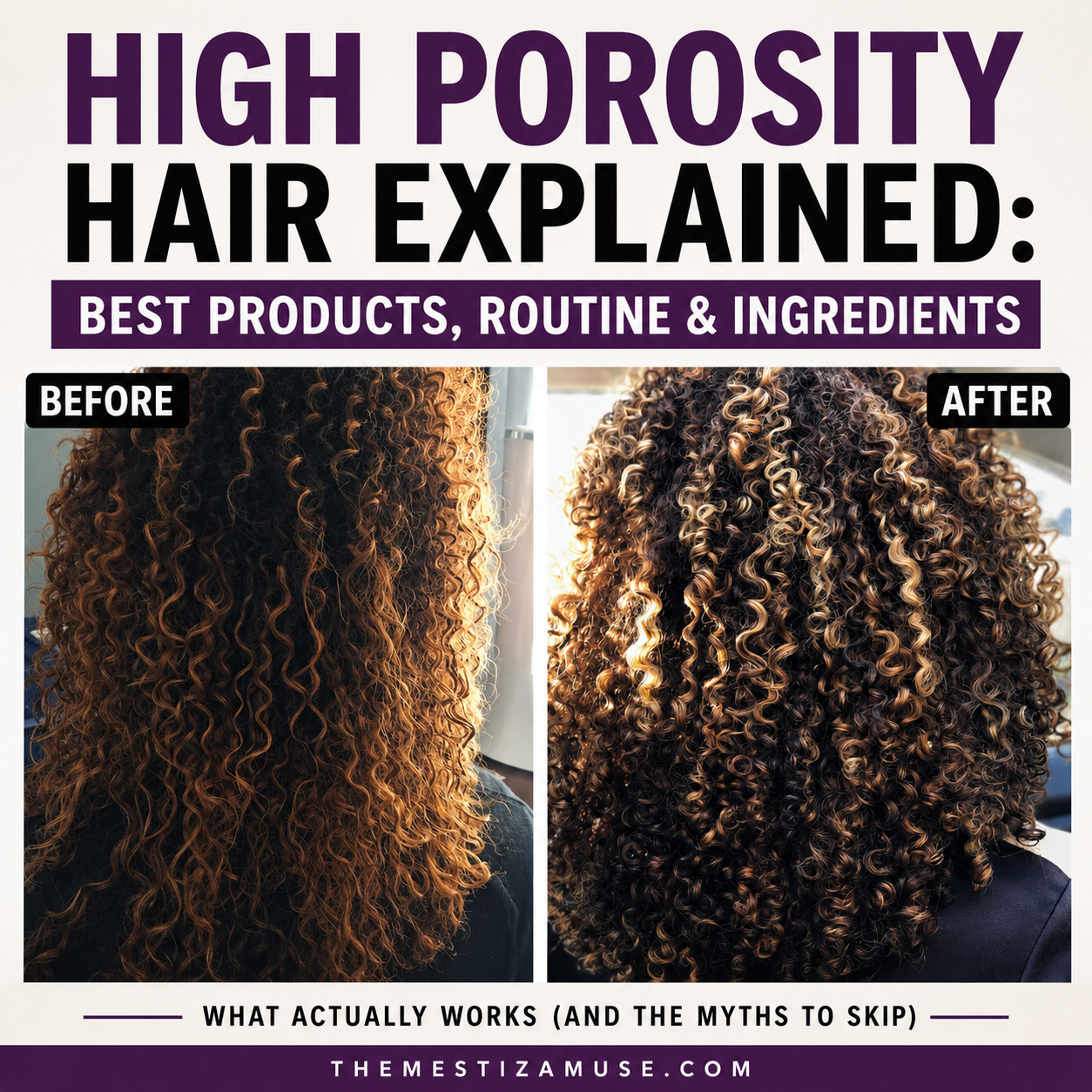
In short: high porosity hair is hair with a worn, lifted cuticle, usually from damage. The goal is not to add water or seal it in; it is to condition the surface, handle the hair gently, and prevent further damage.
What Is High Porosity Hair?

Hair porosity describes how easily water and product move into and out of a strand through the cuticle, the shingle-like outer layer of each hair. [1,2] All hair is permeable to water to some degree; what differs is how quickly that water moves in and out, which comes down to the condition of the cuticle. What we call low or high porosity simply reflects how tight and intact that cuticle is versus how lifted and gapped it has become. [2,4]
The most important shift in understanding is this: porosity is not a permanent hair type. It is a measure of cuticle condition, and for most people higher porosity is a sign of accumulated damage rather than something fixed at birth. [2,3] That is good news, because condition can be protected and managed even when damage cannot be undone. For the full picture of porosity across all hair types, including why the common tests fall short, see my complete hair porosity guide.
Up close, a high porosity strand has a cuticle with lift, gaps, and fissures along its length. [1,2,3] Picture a pine cone: a healthy cuticle lies flat and smooth, while a high porosity cuticle is raised and uneven, so it catches, tangles, and loses water quickly. [4] That openness is also why the strand is structurally weaker and more prone to breakage under tension.

How to Tell If You Have High Porosity Hair
This is where I have changed my advice the most. For years I pointed people to the float test: pluck a clean strand, drop it in a glass of water, and see whether it sinks or floats. Here is what I have come to learn. The float test is not a reliable way to measure porosity. [2] Whether a strand sinks or floats has more to do with trapped air, surface oils, and leftover product than with the true condition of your cuticle. Real porosity is measured with lab instruments, not a drinking glass.
A far better read comes from watching how your hair behaves over time. You likely lean toward high porosity if you notice:
- It feels dry or rough to the touch, even soon after washing
- It soaks up product fast but does not stay soft for long
- It frizzes easily and is hard to settle
- It dries quickly after washing
- It tangles easily and snags on itself
- It looks dull rather than reflective
- It breaks more readily under tension
As Science-y Hair Blog has long pointed out, porosity is best understood through observation: how your hair feels, how it reflects light, and how it responds to products across several wash days.
The honest answer to what is my hair porosity is rarely a single fixed label. It is a current condition you can learn to read, and the only test that truly counts is watching your own hair respond when you change one thing, then give it a few wash days before you judge it.
Types of Porosity Hair: High vs Low vs Medium
Rather than three permanent categories, think of porosity as a range of cuticle condition, defined by the number and size of openings along the cuticle. [9]
| Porosity level | What it reflects | How it tends to behave |
| Low | A tight, intact, smooth cuticle. Often newer or less-processed hair. | Slow to take in water and product; can feel coated or resistant; slow to dry. |
| Medium / normal | A largely intact cuticle with some lift. The middle of the range, not a fixed personality. | Takes in and holds product fairly evenly; generally easy to work with. |
| High | A lifted, gapped, or damaged cuticle. Usually the result of accumulated damage. | Takes in water and product fast, loses it fast; prone to dryness, roughness, frizz, and breakage. |
If you want the other end of the spectrum, see my full guide to low porosity hair and medium porosity hair.
Is High Porosity Hair Genetic?
Partly, but not the way it is usually framed. Your genes set your hair’s baseline structure: your curl pattern, how coarse or fine each strand is, and the shape of the cuticle along it. [6] Tightly curled and coily hair, for example, tends to have a more raised, uneven cuticle along the bends of each coil, so it can behave like higher porosity even when it has never been chemically treated. In that sense, some people do start with a higher baseline than others.
But the high porosity most people are dealing with is acquired, not inherited. It comes from cuticle damage: bleach, color, heat, sun, and friction wearing the surface down over time. [8] That distinction matters because you cannot change your genes, but you can absolutely change the condition of your hair.
Whether your higher porosity is mostly genetic, mostly damage, or a mix of both, the care is the same: condition the surface, handle the hair gently, and limit further damage.
So if you have been asking whether you are stuck with high porosity for life, the honest answer is that your baseline is yours, but how your hair looks, feels, and behaves is very much in your hands.
What Causes High Porosity Hair?
Because high porosity is mostly about damage, it helps to know what lifts and wears down the cuticle in the first place. The most common causes are:
Chemical Treatments
Color, bleach, relaxers, and perms break down the hair’s natural structure and its internal bonds to do their job, which lifts and weakens the cuticle and raises porosity over time. [4,5]
From my hair scientist and cosmetic formulator (PhD in chemistry):
Most high porosity hair traces back to one kind of chemical event. Oxidative services like bleach and permanent color attack the disulfide bonds that hold keratin together and convert cystine into cystic acid. That single change leaves the strand more negatively charged, more water-loving, and weaker, which is exactly why damaged hair tangles, swells, frizzes, and breaks more easily. It is also why positively charged conditioning agents are drawn to damaged hair: they bind to those new negative sites along the cuticle.
Heat Styling
Frequent flat ironing, curling, and high-heat blow drying can lift or fracture the cuticle, pushing porosity higher with repeated exposure. [17]
Environmental Exposure
Sun, wind, and saltwater gradually degrade the cuticle and leave it more open and more fragile. [6]
Mechanical Damage
Rough handling, aggressive brushing, tight styles, and friction from cotton towels and pillowcases physically wear the cuticle away, raising porosity. [5,7,8]
Does Water Hydrate or Moisturize High Porosity Hair?
This is the question I get whenever I say you cannot add water to your hair: but my stylist sprays my hair with water before styling, so is not that hydrating it?
Wetting your hair absolutely does something useful, just not what we have been told. Water temporarily makes the strand more pliable and swells it slightly, which is what lets you reshape curls and work product through evenly. [1] It improves slip, spread, and detangling, so the whole styling process is easier and gentler on fragile high porosity hair. That is real, and it is why stylists wet hair before they cut, comb, and style.
What water does not do is add lasting moisture you can lock in. Once your hair dries, its water content settles back to whatever the humidity around it allows; a strand cannot hold extra water just because you soaked it. [1]In fact, high porosity hair takes water in and gives it up faster than healthy hair, and prolonged soaking can actually stress the strand, which is the swelling behind hygral fatigue. So the spritz helps you style; it is not a treatment that hydrates the hair long term.
Humectants get pulled into this confusion too. They are water-attracting ingredients, but what they do depends on the moisture in the air around you, not on water you apply; on a dry, low dew point day they can pull water out of the hair rather than into it. To understand how humidity and dew point actually drive your hair’s water content, see Understanding Dew Point, Humectants, and Humidity for Curly Hair, and for when humectants help versus when to skip them, see Humectant vs Anti-Humectant: When to Use Them.
And while we are here: rinsing with cold water does not seal the cuticle or lock in shine. Water does not seal anything; if anything, it swells the strand.1 What actually smooths a raised cuticle is the conditioner or masque you applied, which is why your hair feels softer after that step no matter how warm or cool your final rinse is.
How to Care for High Porosity Hair (A Routine That Works)

Forget the old hydrate, seal, and balance mantra. You cannot add water to a hair strand and lock it in; the water content of hair is governed mostly by the humidity around it, not by a product. [1] What you can actually do is simpler and more honest: condition the surface and protect the strand from further damage.
This matters because high porosity hair is already structurally compromised, and that damage usually cannot be reversed; a fresh cut is sometimes the most effective reset. [10] Everything below is about making the hair you have feel smoother and stronger to handle, and slowing down further wear.
Condition Well, and Often
Regular conditioning and deep conditioning improve slip, softness, and elasticity, which makes high porosity hair easier to detangle and less likely to snap while you work with it. [11,12] One thing to be clear about: conditioning is a temporary surface benefit that washes out. It smooths and coats the cuticle for a while; it does not rebuild the inner cortex or permanently lower your porosity. [14]
Bond-building peptide treatments such as K18 are designed to reach the cortex and reconnect broken bonds, a different mechanism from surface conditioning, though independent evidence that they truly rebuild hair structure is still limited. [19]
The single most useful habit: watch how your hair responds to each product over a few wash days. Change one thing, then give it a few wash days before you judge it. That trial on your own hair is the only test that actually tells you what works.
Use Protein When Damage Calls For It (Does High Porosity Hair Need Protein?)
Short answer: high porosity hair does not need protein on a schedule, but it often benefits from it when the hair is damaged. Hydrolyzed proteins and amino acids can temporarily adsorb to the surface of damaged hair, filling in roughness so the strand feels stronger and breaks less during a wash. [12] The effect is real but temporary and washes out; protein is not rebuilding your cortex, and there is no such thing as a fixed protein-moisture balance to chase. Use it when your hair feels weak or overly stretchy, skip it when your hair feels stiff or straw-like, and let your own results guide the frequency.
For the full breakdown of how proteins work and the different types, see Proteins for Curly Hair: Everything You Need to Know. For specific product picks, see Protein Treatments for High Porosity Hair.
Pre-Poo to Reduce Swelling Stress
Applying an oil before you wash can slow how much water rushes into a porous strand, which reduces the swelling and stress that comes with prolonged soaking. [13] Coconut oil is the most studied here and is also associated with reduced protein loss; grapeseed or olive oil are reasonable alternatives if coconut does not suit your hair. [18]
Layer Products to Slow Water Loss
The LOC method (Liquid, Oil, Cream) and LCO method (Liquid, Cream, Oil) are just ways of layering a conditioning product and an oil so the surface stays smoother and loses water more slowly through the day. High porosity hair usually tolerates this layering well. Use whichever order leaves your hair feeling best.
Protect the Strand From Further Damage
Because high porosity hair is already fragile, your biggest wins come from preventing new damage:
- Choose looser styles that do not pull at the hairline, and handle wet hair gently, since it breaks most easily under tension.
- Air dry when you can; if you blow dry, use a warm-to-cool setting to limit heat damage. [4,17]
- Limit long sun exposure, and swap cotton towels and pillowcases for smoother fabrics that create less friction. [6]
A Note on pH Rinses and Apple Cider Vinegar
I used to be a believer in apple cider vinegar rinses. I told readers that a diluted ACV rinse would flatten the cuticle, balance pH, and lock in moisture, and I was sure I could feel the difference.
Here is what I have come to learn. The evidence for ACV specifically doing any of that is very weak. Hair pH does matter, and keeping your products in a mildly acidic range can support a smoother cuticle and more shine. [16] But that benefit comes from well-formulated, pH-appropriate products, not from vinegar in particular. A homemade ACV rinse is unpredictable in strength, easy to over-concentrate, and is not a reliable substitute for a product designed to do the job. If you enjoy it and your hair likes it, it is unlikely to hurt at a high dilution; just know it is not the cuticle-sealing fix it gets credited as.
For the full breakdown of what apple cider vinegar can and cannot do for hair, see Apple Cider Vinegar Hair Rinse: Should You Do It?.

The Truth About Clarifying Shampoos
The curly community treats clarifying shampoo almost like a monthly cleanse ritual, and I understand why. When buildup leaves your hair limp, dull, or unresponsive, a hard reset feels like the answer. So let me be careful here, because the truth is more freeing than the ritual.
A shampoo that actually cleans already removes buildup. For most people, a regular shampoo used properly clears away the sebum, oils, and styling product that accumulate on the hair. Buildup is not a silicone-only problem; it is formula-dependent, and natural oils and your own scalp sebum contribute to it just as much. Whatever the source, it washes out with ordinary cleansing.
So why does clarifying feel so dramatic? Part of it is the contrast. A strong cleanse strips the surface, and then the conditioning agents that follow make the hair feel newly soft. That soft, reset feeling is the conditioning step doing its work, not a special clarifying magic that a normal wash lacks.
Where a true clarifying step does earn its place: right before a bond-repair treatment such as K18, where you want a genuinely clean surface so the treatment can reach the hair. Outside of that, if your everyday shampoo cleans well, a separate weekly clarifying habit is usually unnecessary, and on fragile high porosity hair, over-clarifying just adds wear. Reach for it when your hair genuinely feels coated and unresponsive, not on a calendar.
Best Oils for High Porosity Hair
High porosity hair tends to do well with heavier oils that smooth the surface and slow water loss. [14, 15] Worth trying: castor, coconut, avocado, and olive oils, plus shea and mango butters. Use with a lighter touch the very thin, fast-absorbing oils on their own, since they leave only a light film and slow water loss less than richer oils; and heavy butters used without thorough cleansing, since they can build up.
Coconut oil is the exception to the light-equals-weak idea: it is light but penetrates the strand, which is why it sits in the list above. For the full breakdown, see the most beneficial oils for high porosity hair.
Best Products for High Porosity Hair
The right products are the ones that smooth and condition the surface, support gentle detangling, and limit further damage. Here is what to look for in each category, with a link to the full picks and ingredient breakdown so you can go deeper without the overlap:
Shampoos: gentle, conditioning cleansers that clean without leaving hair stripped and squeaky. Full picks: The Best Shampoos for High Porosity Hair.
Clarifying shampoos: for the occasional genuine deep clean or before a bond treatment, not a weekly habit. Picks: clarifying shampoos for curly hair.
Rinse-out conditioners: strong slip and cationic conditioning agents that detangle and smooth the cuticle fast. Full picks: Rinse-Out Conditioners for High Porosity Hair.
Leave-in conditioners: lasting slip and surface protection that stays on through the day. Full picks: Leave-In Conditioners for High Porosity Hair.
Curl creams: soft definition and a conditioning film that smooths without crunch. Full picks: Curl Creams for High Porosity Hair.
Gels: a flexible cast that sets definition and fights frizz, especially in humidity. Full picks: Best Gels for High Porosity Hair.
Deep conditioners: richer, longer-contact treatments that improve slip and elasticity on very damaged hair. Full picks: Deep Conditioners for High Porosity Hair.
Oils: occlusive films that reduce friction and slow water loss; coconut for pre-poo penetration. Full picks: the most beneficial oils for high porosity hair.
Protein treatments: temporary surface reinforcement for hair that feels weak or breakage-prone. Full picks: Protein Treatments for High Porosity Hair.
Frequently Asked Questions
Is high porosity hair good or bad?
Neither. High porosity simply means your cuticle is more lifted and worn, usually from damage. It calls for a care approach focused on conditioning the surface and protecting the strand, rather than a verdict on your hair. Many people with high porosity hair have gorgeous, healthy-looking results once they stop chasing a label and start handling their hair gently and consistently.
Does high porosity hair dry quickly?
Yes. Because the cuticle is lifted and open, water moves out of the strand quickly, so high porosity hair often air dries faster than lower porosity hair. That same openness is why it can feel dry soon after washing, and why slowing water loss with conditioning and a light oil layer can make the hair feel smoother for longer.
How often should I wash high porosity hair?
It depends on your scalp, your activity level, and the products you use. There is no universal number. Most people do well spacing wash days enough to avoid stripping the hair while still removing buildup. If your hair feels coated and limp, you may be due to cleanse; if it feels dry and brittle, you may be washing too often.
Can high porosity hair become low porosity?
Not in the sense of permanently changing your hair type, because the existing cuticle damage cannot be undone. What you can do is improve the condition and manageability of the hair you have, and prevent new damage so fresh growth comes in healthier. Over time, that is what makes high porosity hair behave better.
Is high porosity hair sensitive to protein?
It varies from person to person, and the only way to know is to try it on your own hair. Some high porosity hair feels stronger and less breakage-prone after a protein treatment, while other hair feels stiff or straw-like. Introduce protein on its own, change nothing else, and judge by how your hair feels over the next few wash days.
References
- Barba C, Martí M, Manich AM, Carilla J, Parra JL, Coderch L. Water absorption/desorption of human hair and nails. Thermochim Acta. 2010;503–504(1):33–9.
- Hessefort YZ, Holland BT, Cloud RW. True porosity measurement of hair: a new way to study hair damage mechanisms. J Cosmet Sci. 2008;59(4):303–15.
- Robinson V. A study of damaged hair. J Soc Cosmet Chem. 1976;27:155–61.
- Velasco MVR, Dias TC de S, Freitas AZ de, Vieira Junior ND, Pinto CAS de O, Kaneko TM, et al. Hair fiber characteristics and methods to evaluate hair physical and mechanical properties. Brazilian J Pharm Sci. 2009;45(1):153–62.
- Horev L. Environmental and cosmetic factors in hair loss and destruction. In: Tur E, editor. Environmental Factors in Skin Diseases. S. Karger AG; 2007. p. 103–17.
- Robbins CR. Chemical and Physical Behavior of Human Hair. 4th ed. New York, NY: Springer; 2002. 483 p.
- Kelly SE, Robinson VNE. The effect of grooming on the hair cuticle. J Soc Cosmet Chem. 1982;33:203–15.
- Robbins C, Kamath Y. Hair breakage during combing. III. The effects of bleaching and conditioning on short and long segment breakage by wet and dry combing of tresses. J Cosmet Sci. 2007;58(4):477–84.
- Dubief C, Mellul M, Loussouarn G, Saint-Léger D. Hair care products. In: Bouillon C, Wilkinson J, editors. The Science of Hair Care. 2nd ed. CRC Press; 2005. p. 141–82.
- Bosley RE, Daveluy S. A primer to natural hair care practices in black patients. Cutis. 2015;95(2):78–80,106.
- Trüeb RM. Aging of hair. J Cosmet Dermatol. 2005;4:60–72.
- Aguh C. Developing a healthy hair regimen I: formulating an optimal cleansing and conditioning regimen. In: Aguh C, Okoye GA, editors. Fundamentals of Ethnic Hair. Cham: Springer; 2017. p. 79–89.
- Keis K, Huemmer CL, Kamath YK. Effect of oil films on moisture vapor absorption on human hair. J Cosmet Sci. 2007;58(2):135–45.
- Barve K, Dighe A. Hair conditioner. In: The Chemistry and Applications of Sustainable Natural Hair Products. Cham: Springer; 2016. p. 37–44.
- Demir E, Acaralı N. Comparison on quality performance of human hair types with herbal oils (grape seed/safflower seed/rosehip) by analysis techniques. ACS Omega. 2023;8(9):8293–302.
- Gavazzoni Dias MFR, de Almeida AM, Cecato PMR, Adriano AR, Pichler J. The shampoo pH can affect the hair: myth or reality? Int J Trichology. 2014;6(3):95–9.
- Lee Y, Kim Y-D, Hyun H-J, Pi L, Jin X, Lee W-S. Hair shaft damage from heat and drying time of hair dryer. Ann Dermatol. 2011;23(4):455–62.
- Rele AS, Mohile RB. Effect of mineral oil, sunflower oil, and coconut oil on prevention of hair damage. J Cosmet Sci. 2003;54(2):175–92.
- Martins E, Castro P, Ribeiro AB, Pereira CF, Casanova F, Vilarinho R, Moreira J, Ramos ÓL. Bleached hair as standard template to insight the performance of commercial hair repair products. Cosmetics. 2024;11(5):150.
Further Reading