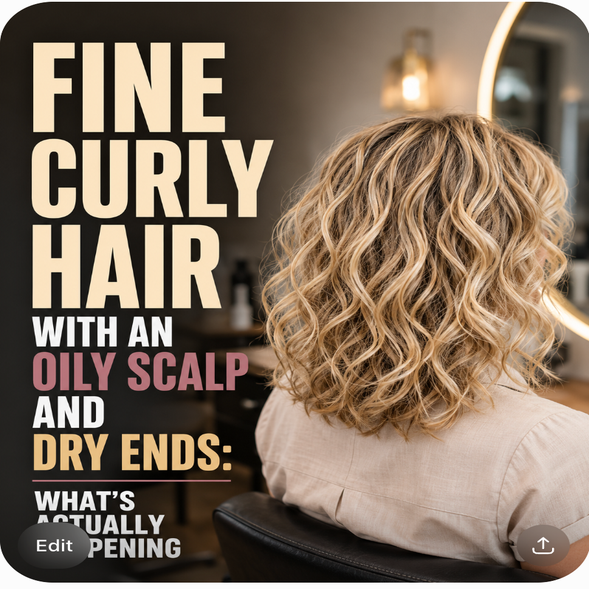
Few things are more frustrating than curls that look amazing soaking wet, then deflate the moment they dry. You did everything right, and by the time you walk out the door the definition is gone. I have lived this for years, and after a lot of trial and error on my own hair I learned that falling curls are almost never about needing more moisture. They come down to weight, hold, and what happens as the water leaves your hair.
The short version: curls fall after drying when the load on the strand (product weight, water, buildup, or humidity) is more than the curl’s hold can support. Lighten the load, add the right hold, and dry with intention, and your curls keep far more of their shape.
Why Do My Curls Look Better Wet Than Dry?
Wet hair is heavy, and that weight pulls your strands into big, smooth clumps, which is exactly why curls look their most defined soaking wet. As the water evaporates, two things happen at once: the hair gets lighter and springs up, and whatever styling film you applied is left to hold each clump together on its own.
If there is enough hold, the clump stays defined. If there is not, or if the curl is weighed down by heavy product, buildup, or water it has taken on from the air, the clump separates and the curl droops. So some wet-to-dry drop is normal; the goal is to give the curl enough support that it keeps most of that definition once dry. A healthy curl holds its shape until something overwhelms it.[1] Everything below is a version of that same load-versus-hold problem, and each one has a fix. For the deeper science, see my guide to how to fix limp curls.
8 Reasons Your Curls Fall Flat After Drying
1. Your Products Are Too Heavy (or You’re Using Too Much)
The most common reason curls fall is simple weight. Rich butters, heavy oils, thick creams, or just too much product form a heavy film that pulls curls down as they dry, and it tends to settle at the roots where you most want lift. Fine, loose, or lower-density curls feel this fastest, because a thinner curl spring buckles under less weight.[1] It is also why hair can look gorgeous wet and limp dry: the water held it up, and once it left, the product weight won.
The fix: go lighter before you go heavier. Use lightweight stylers (a mousse, foam, or light gel) over a single leave-in, in smaller amounts than you think you need. If you layer, keep the total light. You can always add more next wash day; you cannot easily un-weigh a dry style.
2. Your Curls Do Not Have Enough Hold
It is easy to focus on softness and slip and forget that definition needs something to hold it in place. Without a film-forming styler, even well-clumped curls relax and stretch as the day goes on, helped along by movement, humidity, and the hair’s own weight. Soft, fine, and loose patterns lose shape fastest because there is so little structure holding the clump together.
The fix: use a real hold product and let it work. A gel gives the firmest, longest hold (scrunch out the cast once dry); a mousse or foam gives lighter, flexible hold with more volume. Apply a leave-in first, then your hold product on soaking-wet hair. If you have avoided gel because of crunch, that cast is the sign it is working; you just scrunch it out when dry. See my picks for the best mousses and gels for curly hair.
3. You’re Styling at the Wrong Wetness (and Leaving Too Much Water In)
Water is a styling tool, not stored moisture, and how much is in your hair when you style and dry it matters. Most curls clump best when product goes onto soaking-wet hair, so it spreads evenly and the curls group together. But leaving the hair dripping as it air dries can backfire: as all that water slowly evaporates, its weight stretches the clumps and they set looser and flatter.[1]
The fix: apply to soaking-wet hair, then remove some water before drying. Gently squeeze with a microfiber towel or cotton tee, or micro-plop for a few minutes, then diffuse on low or air dry. Diffusing helps the hair set before the weight of the water drags the curl down, which is why so many people get more lasting volume from a diffuser than from air drying alone.
4. Product Buildup and Hard Water Are Weighing You Down
Sometimes nothing in your routine changed and curls still went flat; the culprit is what is sitting on the hair. Styling residue, oils, dry shampoo, and especially hard-water minerals like calcium and magnesium build a rough, heavy layer that weighs curls down and keeps your other products from doing their job.[2] Dull, coated, stretched curls that suddenly resist styling are the classic signs.
The fix: clarify or chelate occasionally. A regular shampoo does not remove minerals well, so a clarifying or chelating wash (about once a month for most people, more often in hard-water areas) lifts the buildup and brings the spring back. See the best clarifying shampoos for curly hair. After clarifying, curls often hold far better with the exact same stylers.
5. Humidity (and Too Much Humectant) Is Working Against You
Your hair constantly trades water with the air, and you cannot fully override that.[1] In humid weather the strand takes on water from the air and swells, so clumps separate, frizz rises, and curls droop, even hours after styling. Humectants like glycerin make that swing bigger: they pull water toward the hair, which helps in moderate conditions but can leave curls limp and frizzy in very humid air, and rough in very dry, cold air.[3]
The fix: treat your routine as seasonal, not fixed. In humid heat, reach for lighter products with more hold and go easier on glycerin-heavy formulas; in cold, dry air, lean on more conditioning support. Drying fully before you head outside also helps curls keep their set. You do not have to avoid glycerin; you just match how much you use to the air you live in. More in my guide to curly hair and humidity.
6. Your Curls Need More Clumping and Structure
Some curls hold with almost no effort; others need help grouping into defined clumps, and without that structure they dry separated and flat. How you distribute product and gather the hair makes a real difference in how defined the curls look once dry.
The fix: build clumps on purpose. Apply stylers with praying hands (smoothing a section between flat palms), then rake, scrunch, finger coil, or use a brush or the ribbon method to gather the hair into uniform groups. Heavier-handed methods suit looser and finer patterns that need encouragement; very tight or fragile curls can frizz with too much handling, so go gently and watch what your hair likes. Then leave it alone to dry, since touching wet clumps breaks them apart.
7. Cuticle Damage Is Weakening Your Curl
Heat, bleach, color, and rough handling roughen and lift the cuticle over time, and a damaged curl does not spring back the way a healthy one does. Contrary to the usual story, damaged hair does not lack water; its rougher, more porous surface actually takes on water more easily, so it swells, frizzes, and loses its clump faster.[2] The rough surface also keeps clumps from gripping one another.
The fix: protect what you have and support the structure. Gentler detangling, less heat, and conditioning to smooth the cuticle all help curls hold better. Protein can temporarily reinforce a weakened cuticle so clumps hold a bit longer; bond-building treatments are promising, but the evidence is still limited and contested, so treat them as one tool rather than a guaranteed fix.[4] And remember porosity is the condition of your cuticle on a spectrum, not a fixed type you are stuck with; as hair gets healthier, it holds better.
8. Nighttime Friction (and Not Letting Curls Set)
You can do everything right and still wake up to flat, stretched curls. Cotton pillowcases wick away the water your hair is holding and rough up the cuticle through friction, while tossing and turning crushes the clumps you worked to build. And on styling days, touching or brushing curls before they are fully dry and cooled breaks the set before it can form.
The fix: protect curls at night and let them set by day. Sleep on satin or silk, or use a satin bonnet, a scarf, or a loose pineapple. While styling, leave the curls alone until they are completely dry, then scrunch out any cast. See my full guide to sleeping with curly hair and preserving curls overnight.
How to Make Your Curls Last All Day
Falling curls almost always trace back to load versus hold, so the fixes stack together:
- Lighten up: lighter products, less of them, especially near the roots.
- Add real hold: a mousse, foam, or gel with a film-former, over one leave-in.
- Mind the water: apply to soaking-wet hair, remove the excess, then diffuse or air dry.
- Clarify when needed: lift buildup and hard-water minerals every few weeks.
- Match the weather: lighter and less humectant in humid heat, more conditioning in dry cold.
- Build clumps: rake, scrunch, or finger coil, then leave them alone to dry.
- Protect at night: satin or silk, a bonnet, or a loose pineapple.
Start with weight and hold; those two solve the majority of curl drop. For the deeper science behind why curls go limp, see how to fix limp curls.
Frequently Asked Questions
Why do my curls fall flat so fast, even by midday?
Usually too much heavy product or not enough hold, sped up by humidity, movement, and buildup. Lighten your products, add a real hold styler over a single leave-in, and check whether buildup or hard water is weighing things down.
Can too much conditioning make my curls fall flat?
Yes, but not because your hair is “over-moisturized.” Heavy conditioning films and humectants add weight, and on fine or loose curls that weight leaves the hair soft, mushy, and unable to hold a clump. It is a load problem. Ease up on rich products and add a styler with more hold.
Does diffusing help curls last longer?
Often, yes. Diffusing dries the hair faster and helps the curl set before the weight of the water stretches it out, so many people get more lasting volume and definition from a diffuser than from air drying alone.
Why do my curls fall flat overnight?
Cotton friction is usually the cause: it wicks away the water your hair is holding and roughs up the cuticle, while tossing and turning crushes your clumps. Sleeping on satin or silk, or using a bonnet or a loose pineapple, protects the shape so you wake up with far less to fix.
References
1. Cloete, E., Khumalo, N. P., & Ngoepe, M. N. (2019). The what, why and how of curly hair: a review. Proceedings of the Royal Society A, 475(2231), 20190516.
2. Robbins, C. R. (2012). Chemical and Physical Behavior of Human Hair (5th ed.). Springer.
3. Gavazzoni Dias, M. F. R. (2015). Hair cosmetics: an overview. International Journal of Trichology, 7(1), 2-15.
4. Martins, et al. (2024). Hair bond builders [review]. Cosmetics, 11.
Keep Reading