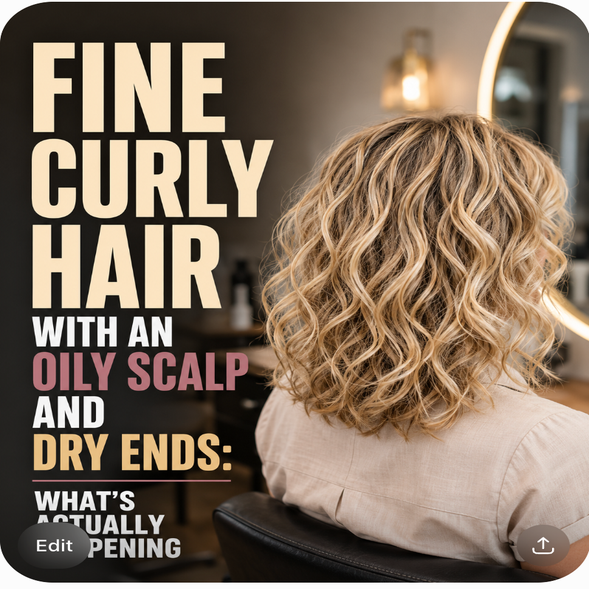
Everyone told me the same thing: if my curls turned greasy this fast, I was washing too much, and all that washing was training my scalp to pump out even more oil. So I washed less. I switched to a co-wash. I treated every sulfate like a threat. My roots got greasier, my curls got flatter, and I leaned on dry shampoo to limp through to the next wash day. The advice was backwards.
Here is what is actually true: how much oil your scalp makes is set mainly by hormones and genetics, not by how often you shampoo. Washing clears the oil already sitting on your scalp; it does not teach the gland to make more. My problem was never wash frequency. It was the wrong cleanser used in the wrong places. So I went back to the person I trust most on formulation, my friend, a hair scientist and cosmetic formulator with a PhD in chemistry, and asked him what actually matters for an oily scalp on curly hair. The answer was the surfactant blend, the weight of what you put on your lengths, and where on your head each product lands.
Short answer: The fix for oily curly hair is not a stronger shampoo or washing less often. It is a gentle but effective surfactant blend, used on your scalp as often as your scalp needs it, with a lightweight conditioner kept to your mid-lengths and ends. Before you change products, rule out the lookalikes: buildup, hard water, heavy stylers, or a scalp condition can all read as oily when they are not.
Why Does Curly Hair Get Oily at the Roots but Dry on the Ends?
Because your scalp and your ends are two different environments, and sebum struggles to travel the spiral. Your scalp is skin, and like the skin on your face it produces sebum, an oily film made of fatty acids, waxes, squalene, and cholesterol that coats and protects.1 On straight hair that sebum slides down the shaft quickly.
On a curve it does not. The oil pools at the roots while the ends, the oldest and most weathered part of the hair, stay comparatively dry. That is why so many curly people have what looks like a contradiction: greasy at the crown, parched at the tips. It is not a moisture problem you fix by piling on more product at the scalp. It is a zoning problem. You cleanse the oily zone properly and you keep the conditioning where the dryness actually is. Treat the scalp like skin and the lengths like fabric, and most of the confusion disappears.
Will Washing My Hair More Often Make My Scalp Produce Even More Oil?
No. This is the single most repeated myth about oily hair, and it does not hold up. Almost every article tells you that washing strips your scalp, so it panics and pumps out more oil to compensate. Sebum does not work that way. How much oil your sebaceous glands make is set mainly by hormones and genetics, not by how recently you shampooed.1 Washing removes the oil that is already sitting on your scalp; it does not train the gland to overproduce.
What people feel as a rebound is usually one of two other things: a cleanser too gentle to actually remove sebum, so the grease returns fast, or heavy product sitting at the roots. If your scalp runs oily, you are allowed to wash it often. The variable that matters is not frequency, it is whether your shampoo is strong enough to clear the oil without leaving your curls stripped. Pick the right cleanser and the frequency takes care of itself.
Do I Really Need a Sulfate-Free Shampoo for Oily Curly Hair?
Not necessarily. Sulfates are not villains, and clarifying once in a while is not a sin. Strong sulfate surfactants are very good at dissolving sebum, which is exactly what some oily scalps want. The reason they get a bad name on curls is that they can be more stripping than your lengths need for an everyday wash, leaving ends rough.2 The smarter framing is to match the strength of the cleanser to the job.
For routine washing, a gentle lathering shampoo built on milder surfactants clears oil well and stays kind to the ends. For the occasional deep reset, a stronger clarifying wash earns its place. What does not work for an oily scalp is the strict no-shampoo, co-wash-only approach: a conditioner cannot emulsify sebum, so oily roots end up limp, heavy, and still dirty. A low-lather shampoo, not a co-wash and not a weekly clarifier, is the everyday sweet spot for most oily curls.
Is It Actually Oil, or Is It Buildup, Hard Water, Heavy Product, or a Scalp Condition?
This is the question the copycat articles skip, and it is the one that saves you money. Greasy-looking, weighed-down, fast-to-flatten hair is not always sebum. Before you buy a new oily-hair shampoo, run through the lookalikes:
- Product or silicone buildup: if hair feels coated, dull, and limp even right after washing, you may be dealing with buildup rather than oil. A gentle cleanser will not shift it.
- Hard water: mineral deposits leave hair stiff, dull, and harder to clean. A chelating wash, not an oil-control shampoo, is the fix.
- Heavy stylers at the root: butters, creams, and oils belong on your ends, not your scalp. At the roots they read as grease within hours.
- A scalp condition: an oily, flaky, itchy scalp can be seborrheic dermatitis or dandruff, which is a different problem with a different fix.
Sort this out first. I wrote separate guides for each so you are not guessing: what scalp buildup really is, the clarifying and chelating shampoos that reset buildup and hard water, and how to tell dandruff from a dry, flaky scalp. If oil is genuinely the issue, read on.
Key Ingredients to Look for in a Shampoo for Oily Curly Hair
This is the part other sites lifted from me word for word and never credited. So here it is the way it should be read: not a shopping list to copy, but a short lesson in why each thing works, so you can read any label yourself. The goal of an oily-hair shampoo is to emulsify and rinse away excess sebum without scouring the ends.
Gentle, Effective Cleansing Agents
Look for sugar-derived glucosides (coco-glucoside, decyl glucoside, lauryl glucoside). They are non-ionic, which means hard-water minerals do not blunt them, they foam moderately, and they lift sebum and product residue without stripping the lengths bare.3 They pair well with other mild surfactants that do the same job gently: sodium cocoyl isethionate (a soft, creamy cleanser), sodium lauroyl or cocoyl glutamate (amino-acid based), and sodium lauroyl sarcosinate (mild, with a satisfying lather). A blend of these on the label is a good sign you have found a daily wash that can actually clear oil while staying curl-friendly.
Light Humectants for Slip, Not Weight
Betaine and propanediol are the two to look for. Betaine is a small, water-binding molecule that improves the feel and surface conditioning of a wash without leaving anything heavy behind; propanediol adds slip and eases friction. Both give you softness and manageability without the limp, coated result that sinks oily curls. And to be clear, glycerin is not the enemy here. It is a perfectly good humectant; it is just heavier-feeling than betaine, so on fine or oily curls some people prefer to let the lighter humectants lead. The problem, when there is one, is usually the amount and what else is layered on, not glycerin itself.
A Touch of Cationic Slip
Small amounts of conditioning polymers like guar hydroxypropyltrimonium chloride and polyquaternium-10 make a shampoo easier to distribute and leave curls easier to comb wet and dry. They carry a light positive charge that clings to hair, so even at low doses they add slip without building up at the scalp. On an oily scalp you want these present but restrained, doing their job on the lengths rather than coating the roots.
Refreshing Extracts
Green tea is rich in polyphenols that act as antioxidants on the hair and scalp,4 while chamomile adds a soft, soothing feel. Citrus (lemon, lime, grapefruit peel oils or extracts) gives that clean, fresh sensation an oily scalp craves. These are finishing touches, not the engine of the formula, but they are why a good oily-hair wash feels genuinely fresh rather than just stripped.
Key Ingredients to Look for in a Conditioner for Oily Curly Hair
Yes, you still need conditioner. You just need a light one, kept off your scalp. Oily curly hair still tangles, and detangling is what protects your ends from breakage. The trick is a conditioner that detangles and softens without piling on weight.
- Light detangling cationics: cetrimonium chloride, cetrimonium methosulfate, behentrimonium chloride, and stearamidopropyl dimethylamine align the cuticle and add slip.5 Shorter-chain cationics are lighter, which is what oily hair wants.
- Light humectants: betaine, propanediol, PCA salts, and hexylene glycol add softness and slip without the heavy, sticky feel.
- Hydrolyzed proteins: wheat, keratin, soy, or vegetable proteins are water-soluble, rinse clean, and lend body to limp curls. They are a conditioning and strengthening helper, not a moisture-balancing act.
- Light oils in small amounts: a little coconut, apricot, avocado, argan, baobab, sunflower, or refined olive oil is fine. The dose is everything; you want a whisper, applied to the ends, not the scalp.
What to Skip in Oily-Hair Products (Think Weight, Not Fear)
The thing to avoid for oily curls is heaviness, not some scary ingredient list. This is not about clean-versus-toxic. It is about what sits and what rinses. For an oily scalp and limp roots, the formulas that cause trouble are the heavy ones:
- Heavy butters and rich oils (shea, large doses of any oil) at the root, which flatten curls and read as grease fast.
- Occlusive petroleum ingredients like mineral oil, petrolatum, and liquid paraffin, which form a film that is hard to wash out.
- Lanolin, a lovely emollient that is simply too sticky and heavy for oily hair.
- Heavy film-forming polymers such as some carbomers and polyacrylates, which can leave a stiff, hard-to-remove coating.
Notice none of those are about being ‘free-from’ anything. Silicones, sulfates, and preservatives are not the problem; weight at the wrong place on your head is. If a product label leans on old fear-based language, that is on the brand, not on you. Read for the role each ingredient plays.
How Do You Wash Oily Curly Hair the Right Way?
Cleanse the scalp, condition the ends, and let gravity do the rest. Technique matters as much as the bottle:
- Shampoo the scalp, not the lengths. Part your hair, apply shampoo at the roots, and massage with your fingertips. As you rinse, the suds slide down and clean your ends for you, no scrubbing required.
- Double-cleanse if you are very oily or use stylers. A first pass lifts the surface, a second actually cleans. This is gentler than hunting for an ever-harsher single wash.
- Condition mid-lengths to ends only. Keep it a clear inch or two off the scalp. This is the whole game for combination hair: oily scalp, dry ends, two zones, two treatments.
- A scalp brush is optional but helpful. It distributes shampoo and loosens oil and flakes evenly.
- Dry shampoo is a refresher, not a wash. It absorbs surface oil between washes; it does not clean the scalp, and leaning on it too hard just adds buildup.
How Often Should You Wash Oily Curly Hair?
As often as your scalp actually needs, which for oily curls is often more than the curly internet allows. There is no virtue in stretching washes if your roots are slick and flat by day two. With a gentle, effective shampoo you can wash every other day, or even daily, without harming your curls; remember, frequent washing does not ramp up oil production. The honest method is to experiment: note how many days it takes for your roots to feel oily, and wash on that rhythm.
Reach for a stronger clarifying wash when your hair feels coated or stops responding to product, not on a rigid calendar. And if you work out or sweat heavily and want something between full washes, a co-wash can have a place, as long as you know it refreshes rather than truly cleanses an oily scalp.
The Short List: Shampoos for Oily Curly Hair
No twelve-product wall of ingredient lists this time. Here is a tight set, chosen by the job it does and by the gentle surfactants above. Check the current label before you buy, since formulas change.
Gentle, Fragrance-Free Daily Wash (Sensitive or Reactive Oily Scalp)
Necessaire The Shampoo. Built on exactly the surfactants worth looking for: sodium lauroyl methyl isethionate, cocamidopropyl betaine, sodium cocoyl isethionate, plus propanediol and a glutamate, with no added fragrance. It clears sweat and oil without leaving the scalp tight, and it is gentle enough for daily use on color-treated curls. Check it on Amazon.
Effective Degreasing Daily Wash (Oily Scalp, Light Botanicals)
Maple Holistics Degrease. This is the one that helped me most when my scalp was at its oiliest. It leans on sodium cocoyl isethionate, betaine, glucosides, and a glutamate, with hydrolyzed proteins and a whisper of light oils (jojoba, peach, lemon, rosemary). It genuinely cuts grease while staying curl-safe. Check it on Amazon.
Lightweight Volumizing Wash (Fine, Limp, Oily Roots)
OUAI Fine Shampoo. For fine curls that go flat fast, this cleanses light and adds body without coating. Cocamidopropyl betaine and a cocoyl taurate keep it gentle; biotin and chia add the volume fine hair wants.
Gentle Micellar Daily Wash With a Touch of Scalp Care
Carol’s Daughter Wash Day Delight. A coco-glucoside, micellar-style water-to-foam wash with a little salicylic acid to keep the scalp clear. Sulfate-free, curl-friendly, and light.
Scalp-Focused Exfoliating Wash (Oily Plus Flaky or Itchy)
Briogeo Scalp Revival Charcoal + Coconut Oil Micro-Exfoliating Shampoo. When an oily scalp is also flaky or itchy, this gentle scrub-wash (isethionate and betaine surfactants, charcoal, tea tree, peppermint) clears oil and loosens flakes. If flaking is persistent, read my dandruff shampoo guide first.
For buildup, hard-water resets, or color-treated hair that needs a stronger clean, I keep those picks in the clarifying shampoo guide so this list stays focused on everyday washing.
Conditioners for Oily Curly Hair
Keep these light, and keep them off your scalp. A few that fit the brief:
- Necessaire The Conditioner. A lightweight, fragrance-free detangling cream that pairs with the shampoo above and adds slip without weight.
- OUAI Fine Conditioner. Light cationics and a touch of protein for body; good for fine, limp curls that drop with anything richer.
- A light protein-leaning rinse-out with hydrolyzed wheat or keratin and short-chain cationics, used mid-to-ends, gives limp curls bounce without buildup. Verify the current formula favors slip and light humectants over heavy butters.
Frequently Asked Questions
Why Is My Hair Greasy Right After I Wash It?
Usually one of three things: a cleanser too gentle to clear sebum, conditioner or styler left on the scalp, or buildup that a mild wash cannot shift. Move conditioner off the roots, try a slightly more effective shampoo or a double-cleanse, and if hair still feels coated, clarify.
Can I Co-Wash if I Have an Oily Scalp?
Occasionally, as a refresh between real washes, especially after sweat. Just know a co-wash does not emulsify sebum, so it will not truly clean an oily scalp on its own. A low-lather shampoo should stay your main event. More on this in the co-wash guide.
Is Dry Shampoo Bad for Oily Curls?
It is fine as a short-term surface refresher; it absorbs oil and buys time. It is not a substitute for cleansing, and overusing it adds buildup that eventually looks like more grease.
My Scalp Is Oily but My Ends Are Dry. What Do I Do?
That is combination hair, and it is the most common pattern in curls. Treat the two zones differently: cleanse the scalp properly, keep conditioner and any oils strictly on the mid-lengths and ends, and do not let root-zone products migrate up.
Sort the cause first: If you are not sure oil is really the problem, start here:
- Scalp buildup: what it is and how to treat it
- Best clarifying shampoos for curly hair
- Dandruff vs. dry scalp: how to tell the difference
- Best dandruff shampoo for curly hair
- Best co-wash for curly hair
References
1. Picardo, M.; Ottaviani, M.; Camera, E.; Mastrofrancesco, A. Sebaceous gland lipids. Dermato-endocrinology 2009, 1 (2), 68-71.
2. Cornwell, P. A review of shampoo surfactant technology: consumer benefits, raw materials, and recent developments. International Journal of Cosmetic Science 2018, 40 (1), 16-30.
3. Clarke, J.; Robbins, C. R.; Schroff, B. Selective removal of sebum components from hair by surfactants. Journal of the Society of Cosmetic Chemists 1989, 40, 309-320.
4. Marsh, J. M.; Davis, S. L.; Fang, R.; Simmonds, M. S.; Groves, P.; Chechik, V. UV Oxidation: Mechanistic Insights Using a Model System. Journal of Cosmetic Science 2021, 72, 697-710.
5. Ran, G.; Zhang, Y.; Song, Q.; Wang, Y.; Cao, D. The adsorption behavior of cationic surfactant onto human hair fibers. Colloids and Surfaces B: Biointerfaces 2009, 68 (1), 106-110.
Keep Reading