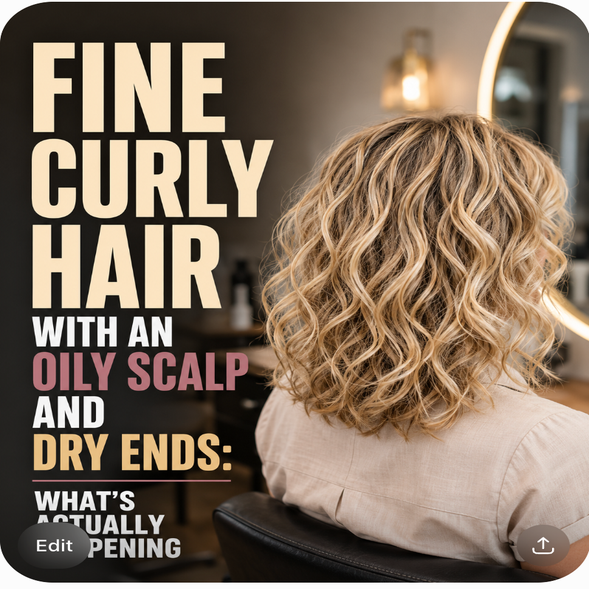
If you have fine curly hair, you already know the specific frustration of it: roots that look oily by the end of the day, ends that still feel dry and snap too easily, and curls that go limp the moment you use a product that’s even slightly too rich. It behaves like two hair types at once, and most shampoo advice written for curly hair in general doesn’t account for that.
This guide is the version I wish I’d had. It’s built around what actually makes fine curly hair different at a structural level, developed with a cosmetic chemist and fact-checked by Leonela, then translated into the specific surfactants and conditioning ingredients that cleanse it without stripping it or weighing it down. There’s a real product list at the end, but the ingredient logic comes first on purpose, because once you understand why a formula works for fine curls, you stop needing anyone’s list and can read a label yourself.
| The short version: Fine curly hair needs a gentle, low-to-moderate detergency cleanser (think glucoside and amino-acid surfactants rather than harsh sulfates) paired with lightweight conditioning that adds slip and a little strength without heaviness. What it does not need is a rich, buttery, high-charge formula built for thick coily hair; on a fine strand, that’s what causes the limp, greasy, weighed-down result. Placement matters as much as the product: cleanse at the scalp, condition from mid-length down. |
What Makes Fine Curly Hair Structurally Different
Two separate things are going on with fine curly hair, and they compound each other. Understanding both is what makes the rest of this guide make sense.
1. The strand is thin, so it shows everything faster
Fine hair simply has a smaller shaft diameter than medium or coarse hair. That means the same amount of sebum, or the same amount of a rich product, coats a thinner strand more completely and reads as heavy, flat, or greasy much faster than it would on a thicker strand. This is the single biggest reason fine curly hair gets weighed down: it isn’t that the products are bad, it’s that a thin strand has a much lower tolerance for weight before it gives out and goes limp.
2. The curl itself has a built-in weak point
Here’s the part almost no consumer article explains, and it’s the real reason fine curls are fragile. Under a microscope, a curved hair fiber isn’t uniform across its cross-section: the cortical cells are distributed asymmetrically, with different cell types concentrated on the outer versus the inner face of each bend.[1][2] That asymmetry, essentially a difference in the ratio of ortho-cortical to para-cortical cells across the curve, is a big part of what makes the hair curl in the first place. But it also means that at the very apex of each bend, the curl point, the fiber is structurally weakest and snaps most easily when force is applied.[3]
Layer fine (thin) on top of curly (built-in weak points), and you get a fiber that is genuinely more fragile than either trait alone would make it, and that also holds less water than straight hair, which is why it trends dry despite the oily-looking roots.[4] That’s not a flaw in your routine. It’s the strand itself, and it’s why fine curly hair rewards gentle handling and gentle formulas so much more than it punishes the occasional missed step.
| Why this matters for wash day: The curl point being the weak point is the whole reason the wet-hair-fragility rule hits fine curls harder than any other hair type. Wet hair is already more vulnerable, and fine curly hair is starting from a more fragile baseline, so detangling gently with conditioner slip (never a brush on dry, bare fine curls) isn’t optional here, it’s the difference between keeping length and constantly snapping it off at the curve. |
How Often Should You Wash Fine Curly Hair?
This is one of the most-searched questions on this exact topic, and it’s also where fine curly hair breaks the usual curly-hair rule. The standard curly advice is ‘wash as little as possible.’ For fine curly hair, that advice actively backfires.
Because a fine strand gets weighed down by oil and product so quickly, going a week or more between washes tends to leave fine curls flat, greasy at the root, and lifeless, the opposite of what infrequent washing does for coarse hair. Most fine curly hair does better washed more often than typical curl advice suggests: often somewhere around two to three times a week, adjusted to how quickly your roots turn oily and your curls fall flat. If your hair looks limp or greasy by day two or three, that’s your signal to wash sooner, not to stretch it further.
The technique matters as much as the frequency: concentrate the cleanser at the scalp, where the oil actually is, and let the rinse-off carry it through your lengths rather than scrubbing your fragile ends. If oily roots are your main struggle, our guide to shampoo for oily curly hair goes deeper on the ‘wash less’ myth, and if your roots are oily while your ends stay parched, the fine curly hair with an oily scalp and dry ends guide is built for exactly that split.
Choosing a Cleansing Blend: The Surfactants That Fit
A shampoo’s cleansing power comes from its surfactants, and the goal for fine curly hair is enough detergency to clear sebum and product without so much that it leaves the hair stripped and rough. That’s a formulation balance, not a single ‘good’ or ‘bad’ ingredient, and it’s worth reading our full surfactant guide if you want the complete picture. The two surfactant families that tend to hit that balance well:
Glucosides (sugar-based)
Decyl glucoside, coco glucoside, and lauryl glucoside are sugar-derived surfactants with solid cleansing performance, moderate foam, and high skin-friendliness. They’re sourced from renewable materials and are readily biodegradable, which is part of why they’ve become the backbone of so many well-formulated gentle, sulfate-free cleansers.[5]
Amino-acid-based surfactants
Sodium lauroyl sarcosinate, sodium lauroyl glutamate, and sodium lauroyl glycinate are gentle, skin-friendly anionic surfactants that still produce a satisfying creamy lather while being kind to the scalp and hair.[6] These are often what a genuinely gentle shampoo is leaning on to clean effectively without the harshness fine hair can’t tolerate.
A note on sulfates, since ‘sulfate-free’ is the headline claim on most of these products: SLS and SLES are efficient, high-foaming cleansers, and the research does show they can be more irritating and can remove more protein than gentler surfactants, especially at high concentration. But that’s a reason to prefer a milder surfactant system for a delicate hair type, not proof that any sulfate in any formula will wreck your hair. The concentration, the rest of the formula, and how you use it all matter. We break down the actual evidence in the surfactant guide.
Conditioning and Strengthening Ingredients Worth Looking For
A good fine-curly shampoo does a little conditioning as it cleanses, so the hair isn’t left rough. The key is that these ingredients stay light. Look for:
- Guar hydroxypropyltrimonium chloride: a guar-derived cationic polymer that gives detangling slip and helps deposit other actives. For fine hair specifically, the low-molecular-weight, low-nitrogen grade is what you want, so it conditions without building up.[7]
- Panthenol (pro-vitamin B5): a lightweight humectant-style ingredient that improves the feel and flexibility of the hair and scalp without adding weight.[8]
- Propanediol: a light, plant-derived ingredient that helps soften and condition dry fine strands.[9]
- Hydrolyzed proteins and amino acids: hydrolyzed wheat protein, wheat amino acids, hydrolyzed keratin, and hydrolyzed vegetable protein can temporarily reinforce the fiber and help reduce breakage, which is especially useful given that built-in curl-point weak spot. Fine hair tends to like protein in small, frequent doses rather than heavy occasional ones.[10]
- Biotin: included as a fiber-conditioning, body-building active in many fine-hair formulas.[10]
- Plant extracts (green tea, chamomile): polyphenol-rich antioxidants that soothe the scalp; a nice-to-have rather than a make-or-break.[11][12]
Ingredients That Tend to Weigh Fine Curly Hair Down
‘Avoid’ is the wrong frame for most of these, since context and concentration matter, but fine curly hair genuinely has a lower tolerance for weight and buildup than other textures, so these are the ones to be cautious with:
- High-charge, high-molecular-weight cationic polymers: polyquaternium-6, -7, and -10 are large molecules with strong affinity for hair. On coarse hair they’re great; on fine hair, repeated use can build up and cause heaviness. Worth noting many good formulas use them low on the ingredient list, where the amount is small enough not to matter, so their presence alone isn’t a dealbreaker.[1]
- Heavy oils and butters at the root: this is about placement and weight, not natural-versus-synthetic. A rich shea butter or coconut oil is just as capable of flattening a fine strand as a heavy silicone would be. Keep anything rich on the ends, never the scalp.
- Alkanolamides (cocamide DEA, lauramide DEA): foam boosters that can carry trace free DEA, which has raised nitrosamine-formation concerns; many formulators have moved away from them in favor of greener alternatives.[13]
- Formaldehyde-releasing preservatives (DMDM hydantoin): worth being aware of; gentler preservative systems (sodium benzoate, potassium sorbate, and similar) are widely available.[14][15]
Our Top Picks for Fine Curly Hair
Every pick below leans on the gentle surfactants and lightweight conditioning covered above. Formulas change, so always check the current bottle for the most accurate ingredient list.
1. Bounce Curl Gentle Clarifying Shampoo
Role: lightweight gentle cleanse with light conditioning
A lightweight, well-foaming formula built on gentle isethionate and glucoside surfactants with panthenol, propanediol, and a baobab protein. It clears buildup and lightly conditions without leaving fine curls stripped, which is a hard balance to strike. One of Verna’s shower staples.
2. Briogeo Curl Charisma Rice Amino + Avocado Hydrating Shampoo
Role: gentle cleanse with amino-acid conditioning
Cleanses without stripping and leans on rice amino acids for lightweight strengthening. It does contain shea butter and a polyquaternium, but both sit low enough in the formula to condition without flattening fine curls. A reliable everyday option.
3. EVOLVh Natural Smart Curl Shampoo
Role: ultra-gentle glucoside cleanse, no buildup
Built on decyl glucoside and a sulfosuccinate with a long list of lightweight plant oils and extracts. Designed to nourish curls of every pattern without buildup, which suits fine hair that goes limp easily.
4. Giovanni Root 66 Max Volume Shampoo
Role: volumizing gentle cleanse for limp fine curls
A sulfate-free, budget-friendly formula built around horsetail extract and designed specifically to add body to fine, limp hair without stripping color. A strong value pick when flatness is the main complaint.
5. Giovanni Tea Tree Triple Treat Shampoo
Role: clarifying, scalp-refreshing cleanse
A more invigorating, scalp-focused wash with tea tree, peppermint, and eucalyptus. Useful in rotation when fine roots get oily fast and need a deeper periodic clean, though it uses a coco-sulfate base, so treat it as an occasional clarifier rather than an everyday gentle wash.
6. Giovanni 50:50 Balanced Hydrating Clarifying Shampoo
Role: gentle everyday-to-clarifying balance
Positioned as gentle enough for regular use while still clarifying, this one balances cleansing with a light hydrating touch. A flexible middle-ground pick.
7. OUAI Fine Hair Shampoo
Role: volumizing, strengthening cleanse built for fine hair
This one is formulated specifically for fine hair, with hydrolyzed keratin and biotin for lightweight strength and chia seed oil for body without heaviness. It cleanses gently and is a strong fit when your fine curls need volume and breakage support in one step. (Note: uses an olefin-sulfonate cleanser, not a sulfate, and is SLS/SLES-free.)
8. TréLuxe Gentle Cleansing Rinse
Role: strengthening low-poo with bond support
An all-natural, gentle cleanser with tomato-ferment extract, keratin amino acids, and squalane, aimed at boosting curl elasticity and reducing moisture loss. A good low-detergency option for fine curls that need strength.
9. Innersense Pure Harmony Hairbath
Role: weightless, silicone-free cleanse for fine-to-medium curls
A weightless, silicone-free hairbath with quinoa and rice proteins, shea, coconut, and avocado in light doses. Explicitly formulated for fine to medium textures that need body and vibrancy without weight. A clean, premium staple.
10. MopTop Gentle Shampoo
Role: moisture-balanced everyday cleanse
A gentle, coconut-based everyday cleanser that keeps curls soft and shiny without heavy detergents. Contains a polyquaternium low in the list, so it conditions lightly without weighing fine hair down.
11. amika Curl Corps Defining Shampoo
Role: lightweight curl-focused cleanse (in-pool swap)
A curl-specific, sulfate-free cleanser that defines and hydrates without heaviness, a widely available, on-theme replacement that fits fine curls looking for definition without weight.
12. Odele Clarifying Shampoo
Role: periodic clarifier for buildup-prone fine curls (in-pool swap)
A sulfate-free clarifying wash for the days fine roots feel coated with product or hard-water residue. Because fine curls build up fast, having a gentle clarifier in rotation is genuinely useful. Pair its use with the buildup diagnosis in our scalp-buildup guide.
13. Rizos Curls Hydrating Shampoo
Role: gently hydrating cleanse
Gently cleanses and soothes with moringa oil, shea, and panthenol, delivering hydration for softer curls. Use a lighter hand on very fine hair, since it leans slightly richer than the most weightless picks here.
14. Pattern Beauty Cleansing Shampoo
Role: gentle clarifying cleanse for curls and coils (in-pool swap)
A gentle-yet-thorough cleanser designed for textured hair, effective at clearing buildup while staying kind to the scalp. A well-loved, widely available option to round out the lineup.
How to Actually Wash Fine Curly Hair
- Focus the shampoo at your scalp. That’s where the oil is. Let the runoff clean your lengths as you rinse instead of scrubbing your fragile ends.
- Be gentle at the curl points. Remember those are your weak spots, use fingertips on the scalp, not nails, and don’t pile and scrub your lengths into a tangle.
- Condition from mid-length to ends only, skipping the roots, so you add slip and softness where it’s needed without flattening your roots.
- Detangle with conditioner in, using fingers or a wide-tooth comb on slick hair, never a brush on dry fine curls. This is the single most protective habit for this hair type; see the wet hair fragility guide for why.
- Wash often enough. For fine curls, that usually means more frequently than general curl advice suggests. Let flatness and oiliness, not a fixed schedule, tell you when.
FAQs
How do I know if my curly hair is actually fine?
Fine refers to the diameter of each individual strand, not how much hair you have. A quick test: roll a single shed strand between your fingers. If you can barely feel it, it’s likely fine; if it feels wiry or thick, it’s coarser. You can have a lot of fine hair (high density) or a little coarse hair, density and fineness are separate things.
Why does my fine curly hair get oily so fast but my ends stay dry?
A thin strand shows oil quickly, and a curl pattern slows sebum from traveling down from your scalp to your ends, so the roots look oily while the ends are starved. It’s a real, common combination with its own dedicated routine, which we cover in the oily-scalp-dry-ends guide linked above.
Does fine curly hair need protein?
Often yes, but in small, frequent doses rather than heavy treatments. Because the curl point is a natural weak spot, lightweight protein (amino acids, hydrolyzed proteins) can help reinforce the fiber and reduce breakage. Just watch for stiffness, which is the sign you’ve overdone it.
Should I avoid sulfates completely?
Not necessarily. Gentler surfactants are a sensible default for a delicate hair type, but a sulfate low in a well-built formula isn’t automatically damaging. It’s the overall formulation and how you use it that matter, not a single ingredient on the label.
Can I use a co-wash instead of shampoo on fine curls?
You can, but cautiously. Co-washing alone often doesn’t clear oil and product thoroughly enough for a fine, easily-weighed-down strand, so many fine curlies find their roots go limp and coated. If you co-wash, keep a gentle shampoo in rotation to actually cleanse the scalp.
Why does my fine curly hair break so easily?
Two reasons stacked together: the strand is thin to begin with, and every curl has a structurally weak point at the apex of its bend where the fiber snaps most easily. Gentle detangling with slip, and lightweight strengthening ingredients, both directly target that fragility.
The Bottom Line
Fine curly hair is thin and curl-fragile at the same time, which is why it wants gentle, lightweight formulas and gentle handling more than any other texture. Reach for mild glucoside and amino-acid cleansers, lightweight conditioning and small doses of protein, and keep the rich stuff off your roots. Wash often enough that your curls stay light and lively rather than flat, handle your curl points with care, and let your own hair, not a rigid rule, guide you. What works for one fine curly head won’t work for every other, so treat this as a map for reading labels yourself, not a script.
References
- [1] Bernard, B. A. Hair shape of curly hair. Journal of the American Academy of Dermatology 2003, 48(6, Suppl.), S120-S126.
- [2] Bryant, H.; Porter, C.; Yang, G. Curly hair: measured differences and contributions to breakage. International Journal of Dermatology 2012, 51, 8-11.
- [3] Syed, A. N.; Syed, M. Curly Hair: Structure, Properties, and Care. Society of Cosmetic Chemists, 75th Annual Meeting, New York, USA, 2021.
- [4] Robbins, C. R. Chemical and Physical Behavior of Human Hair, 5th ed.; Springer, 2012 (moisture content of curly vs. straight fibers).
- [5] Mehling, A.; Kleber, M.; Hensen, H. Comparative studies on the ocular and dermal irritation potential of surfactants. Food and Chemical Toxicology 2007, 45(5), 747-758 (alkyl polyglucoside mildness).
- [6] Ananthapadmanabhan, K. P. Amino-acid surfactants in personal cleansing. Tenside Surfactants Detergents 2019, 56(5), 378-386.
- [7] Corbett, J. F. The chemistry of hair-care products. Journal of the Society of Dyers and Colourists 1976, 92(8), 285-303 (cationic guar conditioning).
- [8] Zviak, C. The Science of Hair Care; Taylor & Francis, 1986 (panthenol).
- [9] Propanediol as a natural humectant/solvent in personal care (supplier technical literature; verify preferred citation before publishing).
- [10] Robbins, C. R. Chemical and Physical Behavior of Human Hair, 5th ed.; Springer, 2012 (protein and fiber strengthening).
- [11] OyetakinWhite, P.; Tribout, H.; Baron, E. Protective mechanisms of green tea polyphenols in skin. Oxidative Medicine and Cellular Longevity 2012, 2012, 560682.
- [12] Srivastava, J. K.; Shankar, E.; Gupta, S. Chamomile: a herbal medicine of the past with a bright future. Molecular Medicine Reports 2010, 3(6), 895-901.
- [13] International Agency for Research on Cancer (IARC) monograph on diethanolamine (nitrosamine formation concern).
- [14] National Toxicology Program. Report on Carcinogens: Formaldehyde.
- [15] de Groot, A. C.; Flyvholm, M.-A.; Lensen, G. Formaldehyde-releasers: relationship to formaldehyde contact allergy. Contact Dermatitis 2009, 61(2), 63-85 (DMDM hydantoin).