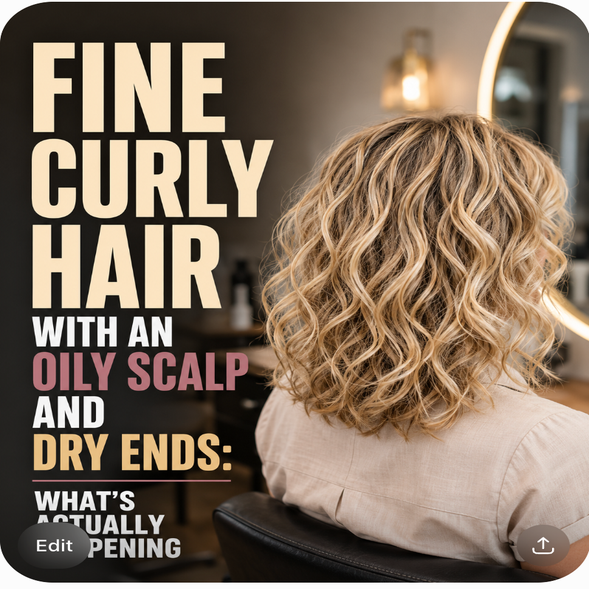
Verna’s profound understanding of curly hair care goes beyond professional experience; it's deeply personal. Not only does Verna have curly hair herself, but her journey with curly hair extends to her children, friends, and family members, each with their unique curly textures.
If you are one of the many people who are gluten intolerant, it is vital to be aware that you can find gluten in hair products.
Gluten in hair products refers to the presence of wheat-derived proteins like gluten in various hair care items. Awareness of gluten in shampoos, conditioners, and styling products is essential for those with gluten intolerance.
This could mean that you may need to be careful about your hair care and beauty products. In collaboration with a hair scientist and cosmetic formulator with a PhD in chemistry, this blog dives into what gluten is, why it’s used in some cosmetic products, and how to identify it in your hair care routine.
Now Available
If you’re looking for gluten-free hair products, I’ve curated a list, which is now available in my shop! You can grab it here.
What is Gluten?
Gluten is a protein mainly found in grains, such as wheat, barley, and oats. It makes up almost 70-80% of wheat’s total protein content.
Wheat is the primary source of gluten, as almost all species of cultivated wheat varieties contain gluten.
It is associated with an allergic reaction in some consumers, particularly people suffering from Celiac disease and gastrointestinal disorders.
The gluten issue is a frequently encountered topic in the food industry. This is why bread and other grain-based items are legally required to declare the gluten content or put a “Gluten-Free” label on them.
Why Is Gluten Found In Cosmetic Products?
Gluten is often a binding agent in hair care and beauty products. It helps to keep the ingredients together and prevents them from separating. Gluten is also used as a thickener in some cosmetic products. It can help to give the shampoo a thicker consistency or prevent liquid foundation from leaking out of the bottle.
Commonly Used Gluten Ingredients in Hair Care
Wheat or oat-derived ingredients are commonly used in hair care formulations. A common and frequently used ingredient is “Hydrolyzed Wheat Protein.”
These ingredients are added for their hair-conditioning properties and are also known to strengthen damaged hair fibers.
As the name suggests, these ingredients are prepared by hydrolysis of protein. The large protein molecules are fragmented into smaller molecular weight fractions. Products containing wheat and oat-derived ingredients may contain gluten.
Does the Gluten Content Pose Any Threat to Your Health?
The question is—does the gluten content in hair care products threaten your health? This is something to look into for consumers who are already on a gluten-free diet and are advised to eat that way. Many blogs and writers have recently addressed this topic. Customers are concerned, and they want a scientific explanation.
Literature Review
In early 2012, the American College of Gastroenterology issued a press release raising an alarm about the presence of gluten-related ingredients in cosmetics.
A particular case was discussed for body lotion and lip care products, which are more likely to be inhaled and thus cause gluten problems.
This press release caused some panic, and as a result, consumers and cosmetic formulators began a new discussion regarding gluten and gluten-free cosmetics. Some manufacturers began labeling their products with a “Gluten-Free” label.
Based on our study and knowledge, no scientific research has discussed the gluten content in cosmetics and quantified its potentially harmful impact on gluten patients.
Moreover, no scientific investigation exists on whether shampoo, conditioner, or other hair care products can pose a threat to Celiac disease when applied to hair or the scalp.
“In 2012, for the first time, a group of scientists examined the gluten content of skincare cosmetics.1
They quantified gluten in lip balm, lipstick, and body lotion. The results found less than 5ppm (part per million) in the given formulations.
The authors highlighted the small concentration of gluten found and the probability of its ingestion. They concluded that it is highly unlikely that this much trace amount of gluten would pose any level of threat to gluten sensitive patients.”
Journal of the Academy of Nutrition and Dietetics
However, the Celiac Disease Foundation says,
“Because lipsticks and lip products are easily ingested, they must be gluten-free. According to research, gluten can’t be absorbed via the scalp or skin, as the gluten molecule is too large to be absorbed through the skin, except for those with active dermatitis herpetiformis, (a skin condition of celiac disease), they should use gluten-free products to avoid contact with any open skin lesions.”
For it to be a concern, it must be ingested to affect those with Celiac disease.
As you have just read, these studies seem contradictory, but they are reputable sources. So, it’s better to err on the side of caution and take the safer course of action.
Safety Assessment
In 2018, the Cosmetic Ingredient Review (CIR) Expert Panel reviewed wheat protein and wheat gluten for their safety in skin and hair care formulations.
The panel concluded these ingredients were safe at the current concentration level of practice. However, they restricted their molecular weight.
The molecular weight for both ingredients needs to be 3,500 Da or less. The details are published in the International Journal of Toxicology.2
Similarly, in 2019, the same Cosmetic Ingredient Review (CIR) Expert Panel concluded that oat-derived ingredients are safe. The panel published the list of oat-derived ingredients, including proteins and polypeptides.3
Facial Cosmetics vs Hair Care Products
A key distinction is between the site of topical application.
When I asked my Cosmetic Chemist friend for his thoughts on the subject, he said:
“Facial cosmetics are applied close to nasal cavities, eyes, and lips (buccal cavity). In that case, products are more likely to be ingested or intake, entering the stomach and assimilating into blood circulation.
However, hair care products only apply to hair fibers or scalp surfaces. There is little chance of gluten ingestion from these routes.”
Essential Tips: Take Home
Not everyone has a gluten sensitivity. A considerable number of people are safe and don’t need to worry. But, if you have a gluten problem, follow your doctor’s advice and instructions.
You can also use the following tips:
✓ Look for gluten-free labels, as most manufacturers mark their products.
✓ Always look at the ingredient list on the product.
✓ Any product with specific wheat or oats listed in the ingredients should be avoided. A shortlist of such ingredients is provided below.
✓ After applying cosmetics to the facial or hair area, wash your hands immediately.
Ingredients to Avoid
✗ Ingredient name starting or containing wheat, gluten, or Triticum (Latin for wheat)
✗ Ingredient name starting or containing Oat or Avena Sativa
✗ Hydrolyzed wheat protein (HWP)
✗ Hydrolyzed wheat gluten
✗ Hydrolyzed oat protein
✗ Quaternized wheat protein
✗ Wheat amino acids
✗ Triticum lipids
✗ Triticum Vulgare
✗ Wheat bran extract
✗ Wheat germ extract
✗ Wheat germ glyceride
✗ Barley extract
✗ Hordeum vulgare extract
✗ Malt extract
✗ Avena sativa extract
✗ Sodium lauroyl oat amino acid
✗ Avena sativa extract
✗ AMP-isostearoyl hydrolyzed wheat protein
Resources
1. Thompson, T.; Grace, T., Gluten in cosmetics: is there a reason for concern? Journal of the Academy of Nutrition and Dietetics 2012, 112 (9), 1316-1323.
2. Burnett, C.; Bergfeld, W. F.; Belsito, D. V.; Hill, R. A.; Klaassen, C. D.; Liebler, D. C.; Marks Jr, J. G.; Shank, R. C.; Slaga, T. J.; Snyder, P. W., Safety assessment of hydrolyzed wheat protein and hydrolyzed wheat gluten as used in cosmetics. International journal of toxicology 2018, 37 (1_suppl), 55S-66S.
3. Becker, L. C.; Bergfeld, W. F.; Belsito, D. V.; Hill, R. A.; Klaassen, C. D.; Liebler, D. C.; Marks Jr, J. G.; Shank, R. C.; Slaga, T. J.; Snyder, P. W., Safety assessment of Avena sativa (oat)-derived ingredients as used in cosmetics. International journal of toxicology 2019, 38 (3_suppl), 23S-47S.