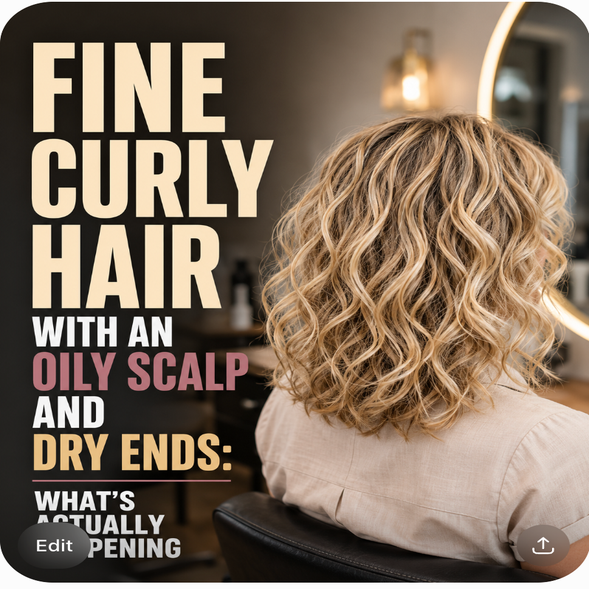
My hair lived in a constant state of damage for years before I ever started an actual healthy hair journey. Bleach, flat irons on the highest setting, relaxer touch-ups on top of new growth, barely any real break in between. I used to swear my hair simply wouldn’t grow past my shoulders. My hair scientist friend, a cosmetic formulator with a PhD in chemistry, finally reframed it for me: my hair was growing the whole time. It just never got a chance to survive the damage I kept putting it through long enough to show up as length.
That’s length retention, and it’s a different problem than growth. My hair didn’t start getting longer when I found a better growth oil. It started getting longer the moment I stopped breaking off what I’d already grown.
Short answer: Your hair is very likely growing at a normal rate already. What most curly hair “growth” problems actually come down to is retention, keeping the length you make instead of losing it to breakage, buildup, and handling. The specific fix depends heavily on your hair’s porosity, so this guide routes you to the right playbook once you know where you stand.
Is Your Curly Hair Actually Not Growing, or Is It Breaking Off?
Hair grows at an average rate of about half an inch a month, which adds up to roughly six inches a year for most people. If your curls have stayed the same length for a year or more, growth itself usually isn’t the problem.[1]
Curly and coily strands are more fragile than straight hair by nature. The bends and coils in the strand are natural weak points, so that same half inch of new growth each month is more likely to snap off before it ever shows up as added length. That’s the real difference between growth and retention: growth happens at the scalp, retention is whether that new hair survives long enough to matter.
The practical test is simple. If you’re finding a lot of hair in your brush, your shower drain, or stuck to your fingers during detangling, that’s breakage working against you, not a stalled growth cycle.

What Actually Slows Hair Growth (and What Usually Doesn’t)
A handful of things can genuinely slow the rate hair grows at the follicle, though for most curly-haired readers, this isn’t where the length is actually being lost.
Stress, physical or emotional, can push hair into telogen effluvium, a temporary shedding phase that follows a stressful event by a few months.[2] Postpartum hair loss works the same way: pregnancy hormones keep more hair in its growth phase than usual, and the drop after childbirth releases it all at once, typically resolving within six months to a year on its own.[3]

Hormonal shifts from thyroid conditions or menopause, certain medications, and genetics can also affect growth rate; both an underactive and an overactive thyroid can trigger this kind of shedding, and it typically reverses once thyroid levels are back in a normal range.[3] These are worth a conversation with a doctor if you notice sudden or patchy shedding rather than gradual, all-over thinning.
What doesn’t move the needle much: rosemary oil and most growth serums. The evidence behind rosemary specifically is thinner than the internet suggests, mostly mouse studies and one flawed human trial, not the “as good as minoxidil” story that gets repeated. I broke down exactly what those studies do and don’t show in Rosemary Oil for Hair Growth: Truth or Hype. Minoxidil is the only topical currently backed by real evidence for regrowth, and that’s a conversation for a dermatologist rather than a shopping list.
The Real Bottleneck: Length Retention
For most curly hair, retention rather than growth is the real project. A few things do most of the damage.
Buildup on the scalp. Product, oil, and hard-water minerals sitting on the scalp can make hair feel weighed down and make styling products harder to work with, though a regular wash with shampoo clears most of it. If buildup is a recurring issue, a clarifying shampoo handles the rest.
Handling and heat. Rough detangling, brushing curls dry, tight elastics, and frequent high heat all create breakage at a rate that can outpace new growth. A few small habit changes make a bigger difference here than any product swap.
The ends specifically. The ends of your hair are the oldest part of the strand and have been through the most wear, so they’re usually the first place breakage shows up. Keeping them conditioned and trimming away split ends before they travel up the strand protects the length you’ve already made.
Find Your Porosity Playbook
Once buildup and handling are under control, the specific moves that help most depend on your hair’s porosity, which describes how easily water and product move into and out of your strand through the cuticle.
Damage history is usually the biggest clue. Hair that’s been colored, bleached, relaxed, or regularly heat styled tends to sit on the higher end of that spectrum, since a rougher, more worn cuticle lets water in and out faster. Hair that’s never been chemically or heat processed and seems to take forever to get fully wet or fully dry tends to sit on the lower end.
How to Grow Low Porosity Hair: Length Retention That Actually Works covers the specific routine for hair that resists product and takes a while to dry.
How to Grow High Porosity Hair: The Ultimate Guide covers the specific routine for hair that soaks up product fast and loses it just as quickly.
Length Retention Habits That Work No Matter Your Porosity
Low manipulation and protective styles. Braids, twists, and buns cut down on the daily friction and tension that wear hair down over time. Give your scalp a break between styles rather than keeping any one style in for too long.
Satin or silk at night. Cotton creates meaningfully more friction against hair than satin or silk does, which is the best-documented reason cotton pillowcases and bonnets are linked to more overnight tangling and breakage. Cotton’s more absorbent fiber structure may also pull some moisture out of hair in contact with it, though that piece is less rigorously measured than the friction difference. Either way, satin or silk cuts down on both.
Gentle detangling. Work from ends to roots with a wide-tooth comb or your fingers, on conditioner-slicked hair, not dry hair. Rushing this step is one of the fastest ways to lose length.
Trims every 10 to 12 weeks. This won’t speed up growth at the follicle, but it stops split ends from traveling up the strand and turning into bigger breakage.
Gentle drying. A microfiber towel or T-shirt creates far less friction than a regular cotton towel, which matters most right after a wash when hair is at its weakest.
When to See a Doctor Instead of Changing Your Routine
Routine changes solve most curly hair length concerns, but a few signs point to something worth getting checked out rather than fixed with a new product.
Sudden or patchy bald spots, scalp pain, redness, or persistent itching, dramatic all-over thinning that shows up over a few weeks, and postpartum shedding that hasn’t slowed down after a year are all reasons to talk to a doctor or a trichologist rather than troubleshoot on your own.
FAQs
Does trimming make hair grow faster?
No. Trims don’t affect the follicle or the rate hair grows at the scalp. What they do is remove split ends before they travel up the strand and turn into bigger breakage, which protects the length you’re already making.
Why does my curly hair feel like it’s not growing even though I get regular trims?
Trims address split ends, but breakage can happen anywhere along the strand from rough handling, heat, or buildup, not just at the ends. If you’re still losing length despite regular trims, the bigger opportunity is usually in detangling technique, heat frequency, or a buildup issue rather than the trim schedule itself.
Do biotin supplements help hair grow?
Only if you’re actually deficient in it, which is uncommon. Reviews of the existing research have found no consistent evidence that biotin improves hair growth in people who aren’t deficient, and clinically meaningful deficiency is rare in anyone eating a reasonably varied diet.[4]
Is curly and coily hair actually slower growing than straight hair?
The growth rate at the follicle is roughly the same across textures. Curly and coily hair looks like it grows slower mainly because the bends in the strand are natural weak points, so more of that growth is lost to breakage before it’s visible as added length.
How long does postpartum hair shedding last?
Most postpartum shedding resolves on its own within about six months to a year as hormone levels stabilize. If it’s still going strong well past that, that’s worth a conversation with a doctor.[3]
Keep Reading
If you know your hair leans low porosity, How to Grow Low Porosity Hair has the full routine. If it leans high porosity, How to Grow High Porosity Hair covers that side of the spectrum. For the buildup piece specifically, 25 best clarifying shampoos for curly hair breaks down which strength to reach for and when, and 10 curly hair mistakes to stop making covers the handling habits that quietly cause the most breakage.
References
[1] Hayashi S, Miyamoto I, Takeda K. “Measurement of Human Hair Growth by Optical Microscopy and Image Analysis.” British Journal of Dermatology, 1991;125(2):123-129.
[2] Hughes EC, Syed HA, Saleh D. “Telogen Effluvium.” StatPearls, National Library of Medicine (NCBI Bookshelf), updated 2024.
[3] Asghar F, Shamim N, Farooque U, Sheikh H, Aqeel R. “Telogen Effluvium: A Review of the Literature.” Cureus, 2020;12(5):e8320.
[4] Patel DP, Swink SM, Castelo-Soccio L. “A Review of the Use of Biotin for Hair Loss.” Skin Appendage Disorders, 2017.